


(The full AMA recording plays in the video pane above, for Dharma Lab members.)
In our 11th AMA, Kim read your questions while Cort made his way back from a retreat with Mingyur Rinpoche. Richie spoke to a study where strangers could tell who the meditators were, from a photo alone.
What’s inside
Full recording and transcript for paid members
The photo study: what strangers saw in the faces of long-term meditators
You are not your beliefs: a simple two-step practice to see them clearly
A 2-minute guided practice (free, led by Dr. Richie Davidson)
The full hour mapped below, plus the flashcards and the recording
Strangers could tell who the meditators were
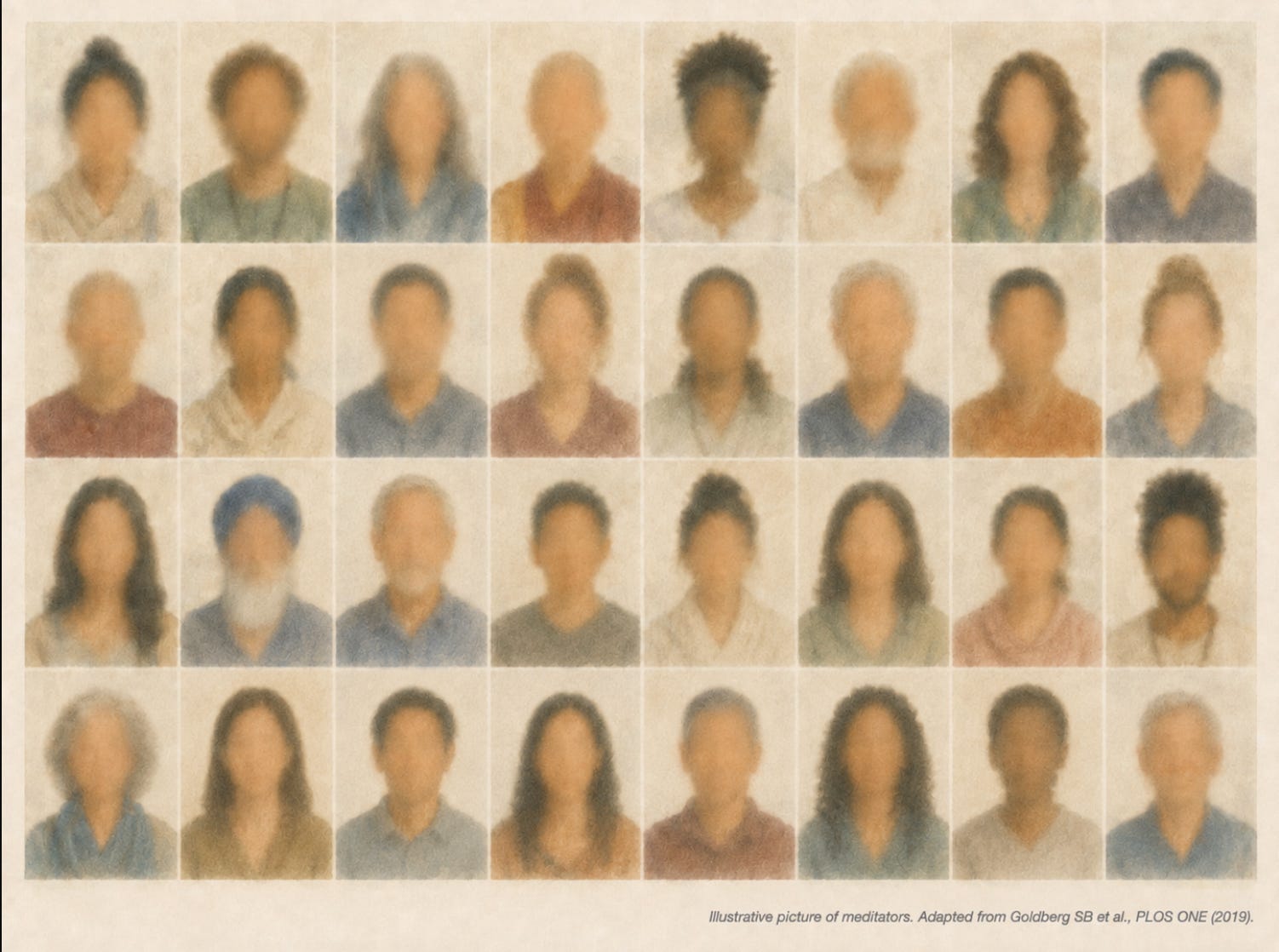
This came up during a question about moods. Richie’s point was that one consequence of long-term practice is that people generally end up in a more positive mood. To show it, he described a study his lab published.
Whenever they studied long-term meditators, they routinely took a picture of everyone, both the meditators and age- and gender-matched controls, without telling them what it was for. Then they gave all the pictures to random people who had no idea where they came from, and asked them to rate each face: how friendly the person is, how much you trust them, how happy they are.
The long-term meditators were judged, in Richie’s words, “whoppingly more positively” than the controls. The raters had no idea where the pictures came from. He called it a powerful, unobtrusive measure that there is something about an enduring mood that gets expressed on the face and that people pick up on.
The study: Goldberg, Hirshberg, Tello, Weng, Flook, Davidson (2019), “Still facial photographs of long-term meditators are perceived by naïve observers as less neurotic, more conscientious and more mindful.”
You are not your beliefs
Another listener asked about the difference between a belief and an ordinary thought. Cort put it this way: thoughts are the words and images moving through the mind, the inner commentary, and they are an expression of deeper beliefs about the world that are often not conscious.
Richie added the distinction he and Cort work with: when we hold beliefs, especially about ourselves, we misconstrue them as a description of who we actually are. He calls it experiential fusion. Most of the time we are not even aware we hold the belief; it just feels like the narrative of our self. Meta-awareness, or metacognition, is having an awareness that we have these beliefs, which lets us recognize we are not necessarily the same as them.
Cort framed the aim in the Tibetan approach he practices: we are not trying to fix ourselves, but to get in touch with the parts that were never broken. Then he gave a two-step practice. First, simply observe your thoughts, like watching a wild animal in its natural habitat, from behind a tree, just watching what it does. Then pause and ask what assumptions, beliefs, and expectations underlie the thought. The point is not to change anything, just to bring the unconscious up to the conscious level.
“We’re not trying to fix ourselves. We’re really trying to get in touch with the parts that were never broken.” — Cortland Dahl
Try this 2-minute practice from the AMA (free, led by Richie)
Prefer to read it? Bring awareness into your body. Then bring to mind one person who first introduced you to practice, who opened this door and shined a light where you had not looked before. Hold them in your heart and let appreciation, gratitude, even love bubble up. Carry that glow into whatever comes next.
The full hour AMA, mapped
Read the gist, then drop into the recording.
04:39 — Is it only meditation that slows brain aging? Compared to athletes or chess players, we don’t yet know. But Richie’s informed conjecture: an altruistic motivation may add a biological benefit over and above the activity itself.
09:12 — What childhood trauma does to the brain. The well-replicated finding of reduced hippocampal volume, and the honest unknown of how far practice can reverse it. Cort on memory reconsolidation.
13:55 — Can practice move your brain’s asymmetry? Functional asymmetry can shift (the first randomized trial of MBSR, 2003), but temperament tends to persist. The masters keep their color; they are not emotional zombies.
20:27 — Belief vs. thought, and how to loosen a harmful one. Experiential fusion vs. meta-awareness, Mingyur Rinpoche’s burnt-rope image, and the two-step practice of watching thoughts and inquiring into the belief beneath.
30:59 — Moods, and the photo study. Why moods differ from emotions, why long-term practitioners carry a positive baseline, and the study where strangers read it off their faces.
38:33 — A stroke, and the beauty in the pauses. For a listener living with brain injury and stroke: being over doing, the sky that stays when the clouds go, and Ram Dass, whose long word-finding pauses Richie found beautiful.
47:28 — After an awakening, why the crash? The four families of retreat experience (body and energy, emotional upheaval, perception, sensing energy), and why to treat them all as passing clouds, not permanent, not the point.
56:16 — What happens in the brain at death. The flatline, why biology is analog and not digital, and the early reports of gamma oscillations near death, the same signature seen in long-term meditators. Plus how the traditions prepare.
Upcoming Events
Save the date: a free practice and meditation hour with Richie and Cort on August 19th at 7pm Central. Register free.


