


In this episode of Dharma Lab, Cortland Dahl and Richard Davidson unpack the difference between experiential fusion, being so absorbed in an experience that awareness narrows, and meta-awareness, the capacity to know what your mind is doing while you’re doing it. They explore why activities like movies, video games, rock climbing, Sudoku, and even doomscrolling can feel good in the moment, how they temporarily suppress the brain’s default mode, and why that does not necessarily translate into lasting change. They also discuss whether meta-awareness actually adds something to positive experiences, how it may increase cognitive and emotional flexibility, and a few simple ways to practice it in everyday life. Enjoy!
Watch on YouTube; Listen on Spotify or Apple Podcasts.
If these conversations are useful, please consider subscribing to our YouTube channel.

Upcoming Events:
From Doing to Being: Effortless Meditation & the Lost Art of Doing Less with Dr. Cortland Dahl and Kasumi Kato, October 9–11 at Omega Institute in Rhinebeck, NY. This is an independent Omega Institute program and is not affiliated with Dharma Lab.
Learn more / register

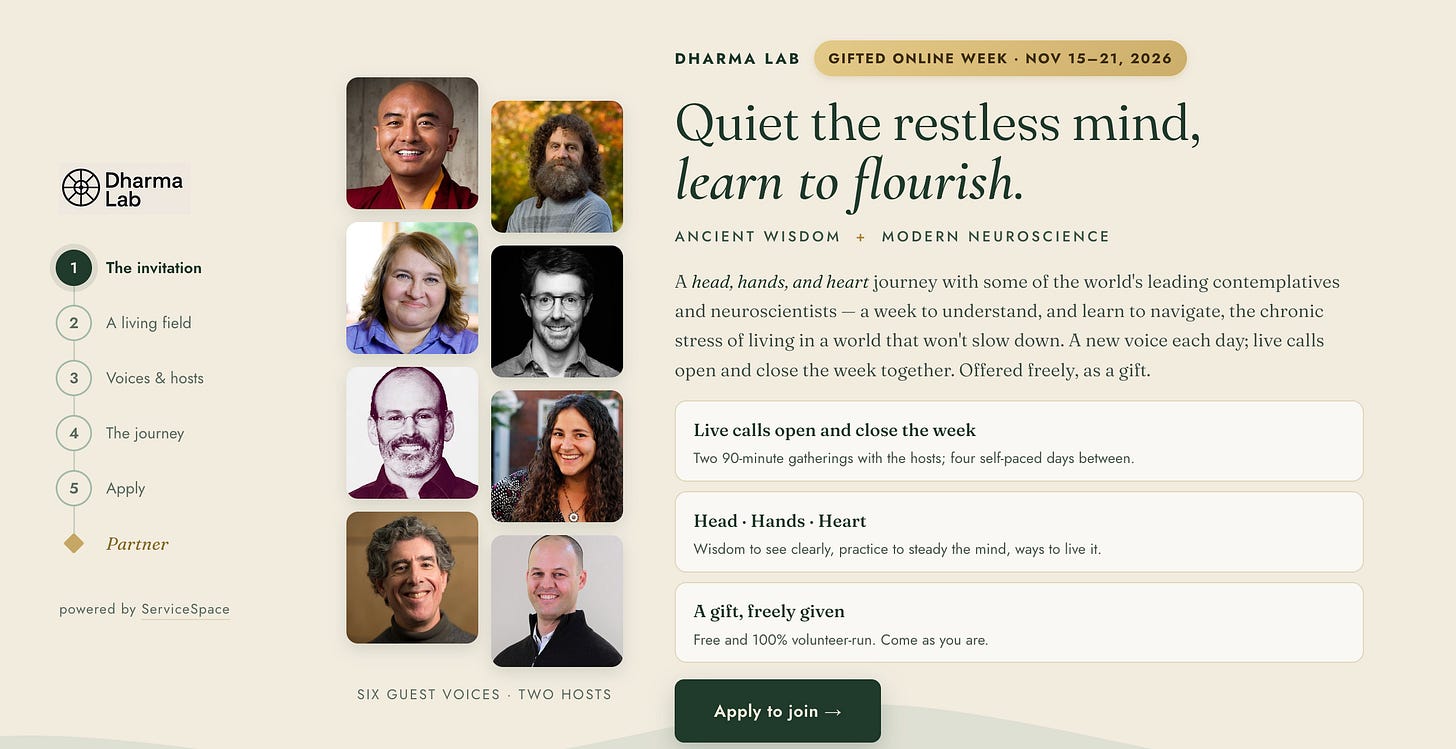
Quiet the Restless Mind — A gifted online week from Dharma Lab and ServiceSpace, November 15–21, exploring chronic stress and human flourishing through ancient wisdom and modern neuroscience, with leading contemplatives and researchers including Robert Sapolsky, Laurie Santos, Mingyur Rinpoche, Judson Brewer, Sharon Salzberg, Martin Picard, Cortland Dahl, and Richard Davidson.

In This Episode:
00:00 Intro: Is It Good to Be Lost?
01:17 Experiential Fusion vs. Meta-Awareness
02:29 What Is Experiential Fusion?
04:55 What Is Meta-Awareness?
06:45 Why Being “Lost” Can Feel Good
09:09 The Default Mode Network and Temporary Relief
11:34 What Meta-Awareness Adds
13:21 Flexibility, Attention, and the Ability to Disengage
14:17 Responding Instead of Reacting
16:53 Can Startle Reveal Meta-Awareness?
19:39 Ancient Meditation Instructions for Meta-Awareness
21:11 How to Practice Meta-Awareness in Daily Life
Written transcript for those who prefer to read:
00:00 Intro: Is It Good to Be Lost?
Cort: We don’t like to ruminate. It’s a deeply unpleasant experience. But isn’t it good to be lost? What’s the problem with being absorbed in a good book or a movie? And would it be better if we had meta-awareness? Does that add anything in a moment like that?
Richie: My view of this is that it feels transiently good. In the movie theater or doing Sudoku, when it ends, we go back to our neurotic self and the default mode of the brain comes roaring back. And so it’s a transient state. Meta-awareness is very helpful, I think, in disengaging our attention and enabling us to be flexible.
01:17 Experiential Fusion vs. Meta-Awareness
Cort: Welcome everyone to another episode of Dharma Lab. I’m Cortland Dahl. I’m here with eminent neuroscientist, And we wanted to talk today about a really important question that you and no one else has ever asked, which is what is the difference between meta awareness and experiential fusion? And I guarantee that although you have not asked that question and probably nobody has ever asked that question, it is one of the most important questions you could ask because it has massive implications for mental health, for emotional well-being, and even for physical health. So these are two terms that we use a lot in our research. We publish papers that are defining these and have been exploring ways to measure them, but they’re just very central to a lot of the work that we do on human flourishing. So why don’t we just start off with, I think, the one that most of us are more familiar with, Richie, and maybe you can... Give some practical examples and share your own insights on this, but that would be experiential fusion. This is, I think, where a lot of us live our lives. So what is this and why should people care? Why is this so important?
02:29 What Is Experiential Fusion?
Richie: Yeah, so experiential fusion is a term that we came up with in a paper we wrote a number of years ago together, and it’s a term that’s used to convey the idea that we can get totally absorbed in an activity that we lose awareness We often call this a flow experience, but we are so completely immersed in the experience that we are no longer aware of our context. So one example of this would be going to a movie and being so engrossed in the movie that you no longer aware that you’re in a movie theater. And in many cases, you’re no longer aware that you’re actually watching a movie. You’re so engrossed in the plot that you’re just in the middle of this plot. That’s experiential fusion.
Cort: And it’s an interesting thing because it can be absorbed in an activity like movie theater example is perfect, a perfect example. You know, reading a really good novel or playing video games can be very absorbing. I think a very common one these days is doom scrolling. You’re just kind of totally caught up in this activity. So experiential fusion can be lost in thoughts, right? It can also be rumination where you’re just lost in your own thoughts. But the interesting thing about these examples, the movie theater example, doom scrolling, playing a video game, actually you’re attentive. It’s not as though you You’re distracted in that moment. In fact, you might be very, very focused on what you’re doing, but it’s as though the light of awareness dims a bit. It’s almost your attention is narrowed into whatever you’re doing and you’re absorbed in it and there’s a feeling of being lost in it. And I think the contrast is when there’s this feeling of almost like you’ve woken up from that. And it does almost feel like you’re waking up when you shift out of that state of absorption. So maybe we could just give the contrast now. So this is experiential fusion, which again, can be everything from you’re daydreaming, you’re ruminating, you’re lost in thoughts, or you’re absorbed in some engrossing activities. We gave these examples, but what’s the alternative? And then we can maybe compare and contrast the two.
04:55 What Is Meta-Awareness?
Richie: Yeah, so the alternative is meta-awareness, and meta-awareness refers to the capacity to know what our minds are doing. And to go back to the movie theater example, how would meta-awareness show up in a movie theater? Well, you might be totally attentive to the movie, completely undistracted, but you’re aware that you’re sitting in a theater, you’re kind of aware in the background. You can think of it as the Penumbra of awareness, the sort of edges of awareness. But you’re aware that you’re sitting in a movie theater, you’re aware that you’re watching a movie, but you’re also completely attentive. There’s no distraction. And that would be an example of meta-awareness. And so as it would apply to everyday life, you can be in a conversation with someone you know well, Be totally in the groove with them, be deep in conversation, but not be lost in the conversation. You can be aware that you’re sitting here, you may have just had breakfast together, and it’s Tuesday, and we’re having this conversation. So that That background is really supplied, if you will, by meta-awareness. Meta-awareness is this faculty of knowing what our minds are doing. And we think, for many different reasons, that meta-awareness is really key to being able to transform your mind. And one of the things I often say is that it’s very difficult to transform our mind if we’re not aware of what’s happening in our mind.
06:45 Why Being “Lost” Can Feel Good
Cort: So when it comes to experiential fusion, as we said, there’s a spectrum there, right? It can be being engrossed in a good book or a movie, or it could even be a conversation with a friend. You’re just totally absorbed in the moment. To the point that you kind of lose touch with everything else other than, you know, the narrow band of what you’re doing. And then on the other end of the spectrum is rumination, being lost in thoughts. I think most people would say obviously rumination is no fun. We don’t like to ruminate. It’s a deeply unpleasant experience. But isn’t it good to be lost? What’s the problem with being absorbed in a good book or a movie? And would it be better if we had meta-awareness? Does that add anything in a moment like that? When we’re reactive or ruminating, clearly we want some meta-awareness, but why would we want it in these other moments? Yeah.
Richie: So those are great questions. And I should just also add that You know, I think we need to ask ourselves the question, why is it that activities that produce this kind of experiential fusion, like going to the movie theater or, you know, some more extreme examples are where flow has been studied. For example, with rock climbers where they’re putting themselves in situations where if there is a lapse in attention, it could potentially be lethal. And they’re doing this voluntarily. And so why do people do these things voluntarily to put themselves in these situations where You know, at least we think most of the time, most people are in this state of experiential fusion. And so my view of this is that it feels transiently good to be in these states of experiential fusion. There are other kinds of states of experiential fusion That are very common as well. So for example, doing crossword puzzles, doing Sudoku, where you’re totally absorbed in an activity that is kind of neutral, is very popular. And so again, I think we need to ask the question, why is that attractive? Why do people voluntarily do that sort of thing?
09:09 The Default Mode Network and Temporary Relief
Richie: The reason is, I think, is because it transiently suppresses the default mode. So what does this mean? Well, we know that the default mode is active when our minds are wandering and when we’re ruminating. And just to be clear, the default mode is a network in the brain. This is like a constellation of brain regions, if you haven’t heard that phrase. Yeah, thank you, Cort. So this kind of activity is really effective in just transiently putting the brakes on this. And so for the time that we’re engaged in the activity, we’re not ruminating. And these kinds of thoughts are blocked, if you will, for the most part. But the thing is, when we stop whatever it is that activity might be, whether we’re rock climbing, In the movie theater or doing Sudoku, when it ends, we go back to our neurotic self and the default mode of the brain comes roaring back. And so it’s a transient state which does not lead to an altered trait to the best of our knowledge. But that’s why it’s experienced as pleasurable.
Cort: So that highlights one of the reasons why even though watching a movie, rock climbing, certain activities are pleasurable and pleasant in part because they’re deactivating the ruminating mind. It’s the part of ourselves that we don’t like to sit with. If you just sit alone in a room doing nothing, if you’re like most people, you’re just going to start thinking. And oftentimes the thoughts that are moving through our minds are not particularly pleasant. So if you can deactivate that, then it feels better than the alternative. But the point you’re making here, Richie, is that although that’s true, and it is a little vacation for
11:34 What Meta-Awareness Adds
Cort: You haven’t developed the ability to manage that yourself. You’ve basically put yourself in a context that is managing it for you. And I think this points to the other side of the question, which is, what does meta-awareness add to these moments? So even if you’re watching the movie and you might say... It feels good to be absorbed. I enjoy that. Why would you want to cultivate meta-awareness, generally speaking? I think it’s for this exact reason. It does two things. One, in my experience, it doesn’t inhibit the pleasant aspects of whatever you’re doing, if you are in one of those positive circumstances. So actually, you enjoy the movie more. It’s not like you enjoy it less. In fact, it’s like you’re aware of a wider spectrum of So if it’s something beautiful, it’s almost like you can appreciate the beauty even more in my experience. So it doesn’t inhibit the enjoyable features, but it brings on the capacity that you are in the driver’s seat of this experience. It’s not just the environment and the context that’s doing it for you. You consciously can do it. You intentionally can do it. And so to me, it’s like a win-win. It both feels good. It helps in a negative situation or a challenging situation. It enhances positive or even neutral situations. And it just puts you in the driver’s seat of your own mind. Is that safe to say? Is that your experience?
Richie: Yeah, I mean, that certainly consists with my experience. But the question you’re asking is a great question. And I don’t really think that we have the adequate scientific evidence to sort of definitively And so I think there’s still work to be done to explore what is the added value of meta-awareness in these situations.
13:21 Flexibility, Attention, and the Ability to Disengage
Richie: I think primarily the added value really is in And, you know, meta-awareness also is very helpful, I think, in disengaging our attention and enabling us to be flexible. And flexibility, both emotionally and cognitively, is an important marker of our skills at cultivating meta-awareness, I think. And so it’s often the case that when we get sort of really intensely focused on an activity, it’s sometimes hard to disengage if we need to do something else. Meta-awareness, I think, will provide the underlying foundation for being able to flexibly shift among various alternatives in our behavior.
14:17 Responding Instead of Reacting
Cort: And, you know, one of the things that I’ve noticed just as an example of that, I mean, meta-awareness by definition, as you said earlier, Richie, is you just know what’s happening in the present moment. You know what’s happening in your mind. You know what’s happening in your body even. You’re more attuned to what’s going on in your environment. And I remember an example of this that I’ll never forget just because the circumstances were so strange. You might have been in the room too when this happened, Richie. I was leading a guided meditation at a retreat that Mingyu Rinpoche was leading. I was kind of doing the guided meditation sessions and it was in Madison. And I was leading this meditation and Jon Kabat-Zinn was there, who’s a friend of ours, a very old friend of yours, Richie, and he was in the front row. And I’ll always remember this just because I was leading a guided meditation to Jon Kabat-Zinn, which is just, it was just like an odd experience. He’s like the godfather of mindfulness and I’ve listened to his meditations a million times. So it was just kind of strange and ironic to be leading a guided meditation. But what happened was behind me, there was like this huge kind of What do you even call it? Like a banner type thing. It was right behind me and it fell down in the middle of the guided meditation and it was literally right behind me and it came like crashing down. And it just so happens that in this guided meditation, I think we were, it was something like I, when that happened, I had this I remember just not flinching because I was totally aware like the moment the sound started happening and then my body and normally, you know, you jump up or something. And it was just very interesting to see just to see the very different reaction in my mind and body just from being in this very meta aware state. Like it gave me some capacity. Of course, if it had something I needed to run out of the room or, you know, there was some real danger, I could have done that. But it was clear that just something had fallen. And I didn’t even know what it was at the time. It wasn’t until later when I looked back and was like, oh, that was that big thing. But it was just interesting to me, just the circumstances because of that. I think I’ll never forget that. But it just shows it just gives you a capacity to notice your own reactions and to respond rather than react when you need to. And when you need to react like that, you can. But a lot of times we don’t need to react like that. And a more thoughtful response is much healthier.
16:53 Can Startle Reveal Meta-Awareness?
Richie: You know, it’s a great example. And, you know, I also think you’re pointing toward a way to potentially differentiate between experiential fusion and meta-awareness, because I would expect that in experiential fusion, you would show a startle response. Well, for sure, you would show a stronger startle response. Yeah.
Cort: And maybe just explain, because this is a scientific measurement that, you know, is used commonly. Could you just explain, like, how you measure that? Like, what is a scientific measurement tool?
Richie: Yeah, so, I mean, startle is something that we show in response to an event that, you know, is often loud or intense in whatever domain it’s in. In the auditory domain, it’s a sound that has a very fast rise time, you know, so it doesn’t slowly ramp up, but it ramps up immediately. And that rise time is really what Triggers the startle and you know we can show startle in even just limited parts of our bodies so one of the ways it’s measured in experimental research is just with the eye blink and so if I did that you know many viewers might just blink their eyes or just show a little bit of something and we can harness that as a measurement tool and actually measure the strength of the eye blink with It measures the muscle around the eye called the orbicularis oculi muscle. And so it turns out that it provides a really useful readout of systems that are important in this regard. And so, you know, in the case of experiential fusion, because it’s more difficult to disengage attention and there’s less flexibility, if there were this loud sound made by the banner falling, it would much more likely elicit a startle response. Whereas if your awareness is really, if the aperture is really big, it would include Whatever is happening in your sensory domains. And so, you know, if there’s a loud sound, there’s a loud sound, but you’re not going to show the same kind of startle because you’re not disengaging your attention from something and allocating to something else. Your attention is already engaged.
Cort: That was it. My attention was wide enough that all that stuff, I was hyper aware of everything that happened. Right. But it wasn’t, you know, locked in here. And then it suddenly had to shift to, you know, to something else. Yeah, it was very interesting.
19:39 Ancient Meditation Instructions for Meta-Awareness
Cort: So it just reminds me, maybe as a final thought on this, some of the most classic teachings from the Buddhist tradition, if you go back to the Buddhist sutras, which are the actual recordings of what the Buddha is said to have taught, there are these lines that are basically meditation instructions. They’re the most boring thing you could ever read. But as meditation instructions, they’re very powerful. And they’re basically meta awareness instructions. So it’ll say things like breathing in a long breath. I know that I am breathing in a long breath. And you just go through all these long lists of all the conceivable things that could be happening in your body and mind. And it’s just, and I know that that’s happening as it happens. And I know that that’s happening. And this is basically him essentially guiding people in meditation. Just know what’s happening in your mind as it’s happening. Know what’s happening in your body as it’s happening. And that’s meta-awareness. And he basically was teaching them meta-awareness as one of the most foundational skills for the entire meditative path. I mean, this goes back thousands of years. It’s really quite interesting.
21:11 How to Practice Meta-Awareness in Daily Life
Cort: Well, that’s great. So any, you wanna close with maybe a final tip, like things you do, maybe we could each just share a way we put this into practice in our own lives. Is there anything that you do that you find helpful to connect with meta-awareness and shift out of experiential fusion?
Richie: Yeah, sure. I mean, for me, I go back to this very frequently, many times a day, just in the course of my everyday life, taking it off the cushion, so to speak. And so, you know, one opportunity to do that is whenever you’re waiting on a line for something, you know, often our attention gets constricted, you know, we’ll Dr. Davidson, Can smile at them, do a little loving kindness for them, just open it up. And, you know, I find myself doing that many times a day in situations just really explicitly widening it as a way to sort of touch in with meta awareness.
Cort: That’s so helpful. Yeah, I do a lot of that as well. Another thing that I do, I’ve mentioned this on other Dharma Lab episodes, I think probably because it was one of my starting practices, it’s still one of my go-to practices. And I think for me, one of the best triggers for meta-awareness is Which is really to feel what’s going on in my body. And sometimes it’ll be very simple. I’ll start with something very obvious, like the feeling of my feet on the ground and just feel that for a few moments. And sometimes from there, a little awareness through my body. Usually I’ll notice, you know, sometimes I’ll notice a little bit of tension in my shoulders and they’ll relax a bit or some tension in my jaws. I just naturally feel like my body just opens and relaxes a little bit. Which is always interesting to me after more than 30 years of doing this, that the body is just holding a lot of tension all the time. And awareness itself has this relaxing quality. So just the fuel, what I’m feeling in my body for me is just a very simple kind of anytime, anywhere, everywhere, all the time kind of practice. So that’s one of my go-to practices. So Both of those are great experimentation points. Those of you listening, if you haven’t tried these, I’m sure you have yours as well. If you have your own practices that spark meta-awareness for you, we’d love to hear about it. So maybe you could mention in the comments or share the practices and insights you’ve had. But in any case, great conversation, Richie. Thank you not only for sharing your insights, but for all the research you’ve done on this. You’ve been the pioneering researcher in this area. And I imagine we’re going to have many, many more conversations about meta-awareness and experiential fusion. So stay tuned to future episodes of Dharma Lab if you found this helpful. So take care.


