


This past Saturday morning, Cort and Richie sat down for an informal conversation building on our recent article mapping the landscape of contemplative science. They explored a number of fascinating questions focused on their personal experiences within the framework: what the essence of meditation really is, how different practices can be grouped into distinct families, and why that framework matters for both science and practice. Below, we share a summary of the conversation along with the full recorded session. (Our next live Ask Me Anything with Richie and Cort is scheduled for April 14 at 8pm ET, send questions in advance!)

The Dalai Lama has told Richie Davidson on several occasions that when he sits down to meditate, he thinks about his brain changing. Based on decades of interaction with Richie’s research, he finds it inspiring to know that his practice is altering the structure of his brain.
When Mingyur Rinpoche is asked by beginners what the essence of meditation is, he gives a disarmingly simple answer:
“The essence of meditation is awareness.” — Mingyur Rinpoche
It sounds straightforward. But as discussed on Dharma Lab, this single quality opens the door to a vast inner universe. In a landmark paper published in Trends in Cognitive Sciences, Cort, Antoine Lutz, and Richie mapped the terrain of contemplative practice, categorizing the full range of meditation into three families based on their cognitive mechanisms. The goal was to give scientists a common language and a deeper understanding of the biology behind these practices. To move beyond the general term “mindfulness” and understand the full range of contemplative tools available to us.
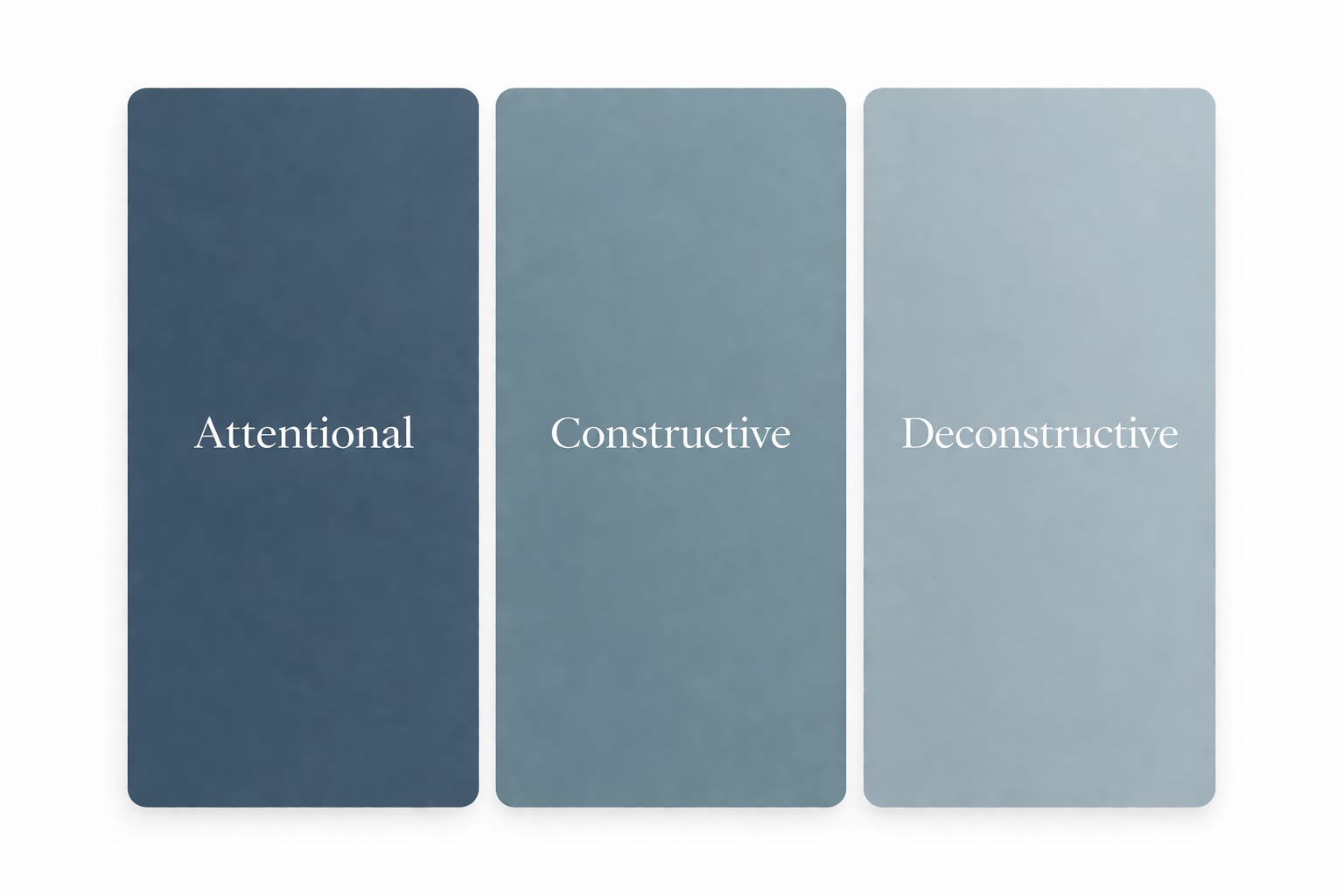
The practices fall into three families: Attentional, Constructive, and Deconstructive. The categories are not hard and fast. Most practices have attentional elements. But the primary emphasis of each offers a fundamentally different path to well-being, and they activate entirely different networks in the brain.
The Attentional Family: The Foundation
The attentional family is the fundamental family. It is about training your capacity to pay attention. As Richie puts it:
“We all have this quality of awareness. And what we do in the attentional family of meditation is we connect to that quality.” — Richie Davidson
You can connect to awareness through sound, bodily feelings, thoughts, or emotions. You can recognize awareness itself. You can recognize the spacious qualities of awareness. And you can recognize something Richie calls the “aperture” of awareness: the narrowness or wideness of what you are attending to.
As discussed on Dharma Lab, there are two key elements of any attentional practice. The first and most fundamental is presence itself: learning to be more fully tuned in to what is happening versus being on autopilot, absorbed, or distracted. The second is the attentional component: the aperture, meaning how wide, how narrow, and where you are shining the spotlight of attention.
Cort describes this spectrum from direct experience. During a month-long retreat in Myanmar, Cort spent weeks doing body scan practice and found he could get his attentional focus down to an almost atomic level, a high-powered laser beam of concentration. On the other end of the spectrum are practices where you widen focus until it is all-encompassing, almost without boundary. Effortless and expansive versus narrowly focused and fine-tuned. Different practices on the same attentional spectrum, all doing different things in the mind.
“It’s kind of like being an explorer out in the world, exploring new terrain that nobody’s been to. We’re doing the same thing. We’re just exploring the inner universe of our own minds.” — Cortland Dahl
Cort also spent years delivering pizzas in college, using those drives to practice awareness. Everywhere, all the time. He found that moments that would normally be filled with boredom or autopilot became moments of practice. What was once dead time became alive. This is what Mingyur Rinpoche built an entire program around, called Anywhere, Anytime Meditation: the idea that we can harness this quality of awareness anywhere, anytime.
47%
The typical person is not paying attention to what they are doing for nearly half of their waking life. (As discussed on Dharma Lab HERE referencing the 2010 Killingsworth Study)
By strengthening our capacity to connect with awareness, it becomes more spontaneously available in daily life. Standing in an airport security line, you might notice the sounds of the x-ray machines, the sensations in your body, the people around you. Not because you forced yourself to pay attention, but because awareness showed up on its own.
That is what practice does. It makes awareness available anywhere, anytime.
The Constructive Family: Nurturing What Is Already There
While attentional practices are about observing, constructive practices are about generating. Compassion, loving-kindness, gratitude. We call them “constructive” because we are strengthening, developing, or nurturing qualities that we believe are innate. In Born to Flourish, we detail the research showing that kindness and prosocial behavior are built into our biology.
This family also includes practices centered on devotion, like the Tibetan practice of Guru Yoga, where the emphasis is on constructing a specific state of mind through relationship and imagination. And it includes reappraisal: changing the story you tell yourself about an experience. From the constructive view, reappraisal shifts your interpretation from anxiety to compassion. From the insight view, it is less about changing the story and more about seeing it clearly.
The Deconstructive Family: Who Is Asking the Question?
The third family is deconstructive. This focuses on a curiosity-driven interrogation of the narratives we carry about ourselves. This is the kind of practice the Dalai Lama primarily engages in. He really doesn’t do much in terms of traditional mindfulness practice as we think about it in the West. A major portion of his practice is focused on this kind of investigation.
When we say “I am anxious,” who is this “I”? Is it all of me? Is there any part of me that is not anxious? Who is the “I” that is asking this question?
“It’s really investigating what we mean when we use a term like ‘I’ or ‘me.’” — Richie Davidson
By probing these questions, we deconstruct the rigid sense of self that often causes suffering. These practices fall under the “Insight” pillar of our framework (Awareness, Connection, Insight, and Purpose) and are essential for understanding the very nature of reality and consciousness.
Seeing clearly is the key mechanism. Not trying to stop or change or alter. Just seeing.
Things You Can Do
The best practice is the one you actually do. We encourage you to experiment in a playful way. Here are three starting points.
The “Airport Security” Practice
Next time you are in a mundane situation, a waiting room, a grocery line, a red light, tune in. Notice the sounds. The sights. The sensations in your body. See what it feels like to let awareness find you rather than forcing your attention somewhere.
Explore Your Aperture
Spend one minute with a narrow focus, like your breath, then one minute with a wide focus: all sounds in the room, all sensations at once. Notice the difference. Notice how each feels in the body. This is the attentional spectrum Cort and Richie describe, from atom-level to all-encompassing.
Ask “Who Am I?”
When a strong emotion arises, gently ask yourself who is experiencing it. Not to answer the question, but to notice what happens when you ask. Can you find the “I” that is doing the asking? This is deconstructive practice in its simplest form.
Final Thoughts
Our purpose at Dharma Lab is to give you insight into the real science coming out of the Center for Healthy Minds. As an interdisciplinary research center that has been at this since 2010, when the Dalai Lama inaugurated the center, we are in a unique position to share not just the findings, but the backstory. The seminal papers. The behind-the-scenes conversations.
The three families framework maps the full terrain of contemplative practice. Different brain networks. Different paths to well-being. One shared quality at the foundation of all of it: awareness.
We hope this framework helps you understand not just how to practice, but why it works. And we hope you will bring that understanding into your own life, everywhere, all the time.
This is the first in a series where we will go deeper into the science behind these practices. Was this helpful? Is there anything you would like us to explore further? Let us know in the comments or reply to this email. We read every response.
Key Quotes
On the Essence of Meditation: “The essence of meditation is awareness.” — Mingyur Rinpoche
On Neuroplasticity and the Dalai Lama: “He actually thinks about his brain changing based on the interactions he’s had with us. And he said he’s really inspired by that, inspired to know that the practices that he’s doing are actually changing his brain.” — Richie Davidson
On Compassion vs. Empathy: “Empathy is really about feeling the emotions of another person, whereas compassion is more about preparing to relieve the suffering of another person.” — Richie Davidson
On Exploring the Inner Universe: “It’s kind of like being an explorer out in the world, exploring new terrain. We’re doing the same thing. We’re just exploring the inner universe of our own minds.” — Cortland Dahl
On Deconstructive Practice: “It’s really investigating what we mean when we use a term like ‘I’ or ‘me.’” — Richie Davidson
Key Stat: 47% of our waking lives, the typical person is not paying attention to what they are doing.
Show Notes and Resources
Papers Cited
Dahl, C.J., Lutz, A., & Davidson, R.J. (2015). “Reconstructing and deconstructing the self: cognitive mechanisms in meditation practice.” Trends in Cognitive Sciences, 19(9), 515–523.
Killingsworth, M.A. & Gilbert, D.T. (2010). “A Wandering Mind Is an Unhappy Mind.” Science, 330(6006), 932.
Book
Born to Flourish by Richie Davidson and Cortland Dahl. Explores the four pillars of well-being: Awareness, Connection, Insight, and Purpose.
Apps and Programs
Community
Related Dharma Lab Posts
Previous post: Summary of the three families framework from the TICS paper
Nothing more nothing less. Naked awareness as it is ❤️🎇💎
🤍🤍🤍