


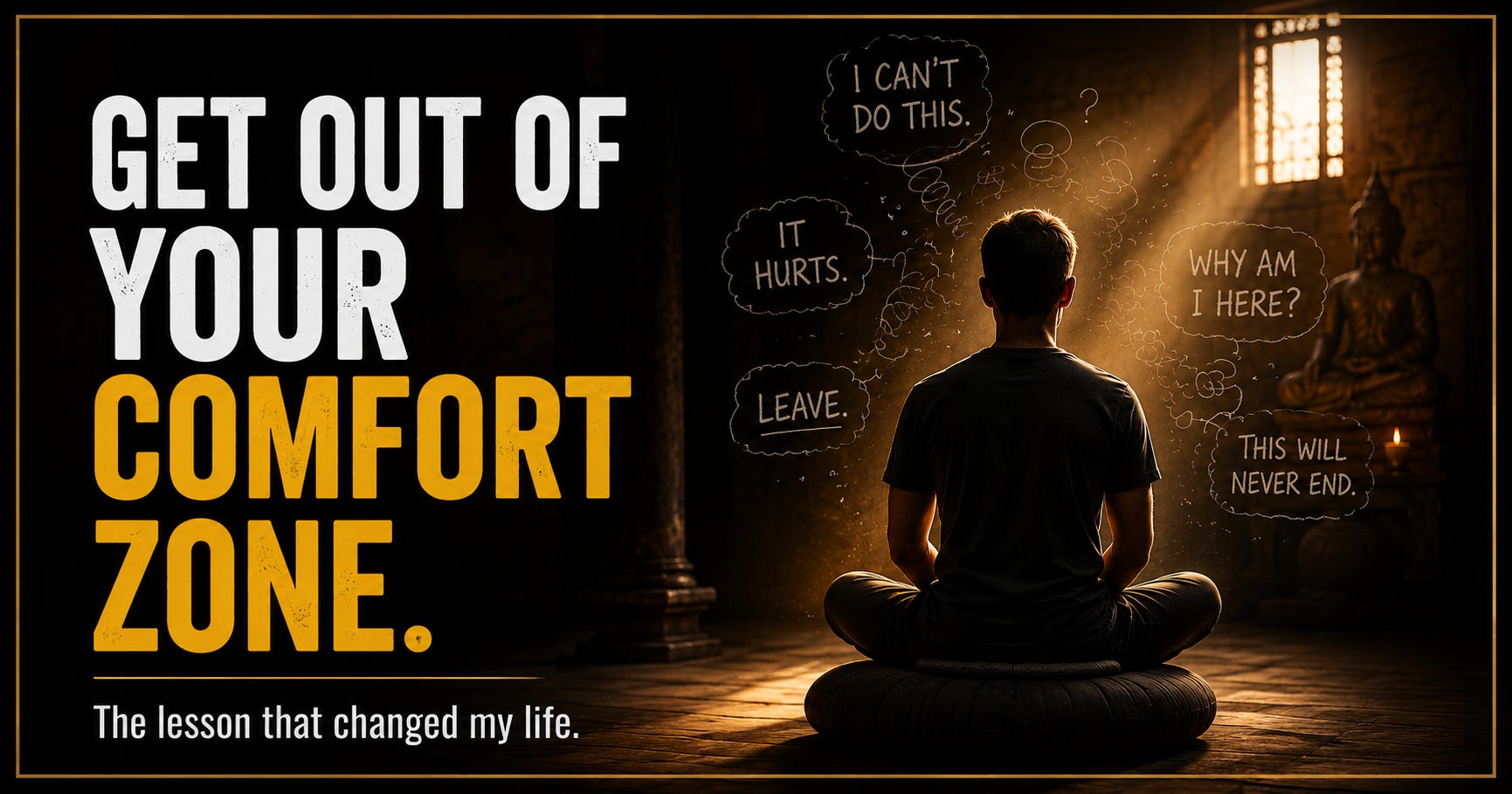
“Get out of your comfort zone.”
It’s one of the most common pieces of advice you’ll hear if you want to grow. We say it about careers, relationships, exercise, and learning new skills. But what if we’ve misunderstood what it really means?
For most people, getting out of your comfort zone means doing something outwardly challenging. Giving a presentation. Starting a business. Having a difficult conversation. Taking a risk.
My own experience taught me something very different.
The most uncomfortable experience of my life didn’t happen while climbing a mountain or taking some big leap of faith. It happened in complete silence, sitting cross-legged on a meditation cushion in a small monastery in Myanmar…
Join Cort and Richie for a FREE MEDITATION / PRACTICE HOUR
On Wednesday, August 19 at 7 PM CT, Richie and Cort are hosting a free hour on Zoom — how different meditation practices map to the four pillars of well-being, with guided practice throughout. All are welcome.

A Month of Struggle
In the late 1990s, I decided to do my first month-long meditation retreat.
Up until then, I had done plenty of weekend retreats and even a few that lasted a week. But I wanted to see what would happen if I really immersed myself in practice.
There was just one problem: I was a graduate student living on a shoestring budget, and the retreat centers I found in the United States were far beyond what I could afford.
Then a friend told me about monasteries in Asia where foreigners could do long retreats on a donation basis. A few months later, I packed a backpack, bought the cheapest ticket I could find, and flew to Myanmar.
I had no real idea what I was getting myself into.
The schedule was relentless.
We practiced twelve to fifteen hours a day, alternating between sitting meditation and walking meditation from before dawn until well into the evening. There was a simple breakfast, a modest lunch, and no dinner. Beyond that, there was little to do except meditate.
For the first few days, I practiced mindful breathing to settle my mind. Then my teacher instructed me to begin a traditional body scan meditation.
The practice sounds deceptively simple.
You place your attention on the top of your head, noticing whatever sensations are present. Then, very slowly and methodically, you move your attention downward—across the forehead, face, neck, shoulders, arms, chest, abdomen, hips, legs, feet, and finally the tips of your toes.
Simple, but not easy.
Within a few days, I felt like I was crawling out of my skin.
Years earlier, I’d been in a couple of car accidents that left me with chronic back pain and recurring headaches. Sitting motionless for hour after hour brought all of that roaring back to life. My knees ached. My back burned. Muscles I didn’t even know I had began protesting. My mind rebelled with equal enthusiasm.
Every sitting session felt like an endurance contest.
I would watch the clock, convinced that at least twenty minutes must have passed, only to discover it had been three.
Over and over again, I found myself fantasizing about leaving. I imagined walking out of the meditation hall, finding a taxi, heading straight to the airport, and getting on the first flight home.
The Insights that Followed
Looking back, it’s almost funny. If someone had walked into that monastery and asked me whether I was enjoying myself, I probably would have laughed. It was not peaceful. It wasn’t blissful. It wasn’t even relaxing. It was, by almost any ordinary standard, a miserable month.
I’d love to tell you that halfway through everything suddenly became effortless. That I broke through some invisible barrier and spent the rest of the retreat floating around in perfect serenity. That isn’t what happened. The retreat remained difficult almost from beginning to end.
And yet, something else was happening beneath the surface. Slowly, almost imperceptibly, I began to notice things about my mind that I’d never seen before. I saw the difference between pain and suffering. Until then, I’d assumed they were basically the same thing. But during those endless hours on the cushion, I began to see that while pain is an unavoidable part of being human, much of what we call suffering comes from something else entirely. It comes from resistance, from wanting things to be different than they are, from fighting reality instead of meeting it.
I also noticed the enormous gap between my expectations and my actual experience. I wanted the retreat to be peaceful. I wanted my mind to settle down. I wanted profound meditation experiences. Instead, I got sore knees, a throbbing back, endless restlessness, and a mind that seemed determined to think about absolutely everything except meditation.
It slowly dawned on me that much of my suffering wasn’t coming from the retreat itself. It lived in the gap between the experience I was having and the experience I thought I should be having.
I also saw something even more unsettling. Much of my striving—the relentless effort to control my mind and force myself into becoming a better meditator—was rooted in a quiet but persistent belief that I wasn’t good enough as I was. That if I just tried harder, practiced more, controlled my experience a little more successfully, then I’d finally arrive somewhere better. And it was about much more than just meditation. It was how I viewed my entire life. My entire conception of my worth as a human being was tied to doing and achieving. That realization has stayed with me ever since.
The Biggest Lesson of All
The biggest lesson came years later, when I looked back on that month with a little perspective. What struck me wasn’t how difficult it had been. It was where all the real growth had happened.
Nearly every insight that fundamentally changed the way I understood myself, meditation, and life had emerged from the moments I least wanted to experience.
Not despite the difficulty.
Because of it.
Self-discovery and inner transformation is often born from adversity.
Now, before going any further, I want to make one thing clear. I’m not suggesting that all adversity leads to wisdom. Sometimes hardship is simply too much. Trauma, chronic stress, abuse, or overwhelming loss can push us beyond our capacity to cope. When that happens, adversity doesn’t necessarily foster growth. It can leave us feeling frightened, disconnected, or deeply wounded. Healing often requires safety, support, and time before insight becomes possible.
But there is another kind of difficulty. A kind that stretches us without breaking us. A kind that invites us to discover strengths we didn’t know we possessed. Over the years, I’ve become convinced that this is where much of our deepest growth takes place, not only in meditation, but in every part of life.
And yet, it’s exactly the kind of experience we spend most of our lives trying to avoid.
Chasing a Mirage
In many ways, this is totally understandable. Modern life is built around the pursuit of comfort.
One of the great triumphs of civilization has been our ability to reduce unnecessary suffering. Most of us no longer spend our days worrying about where our next meal will come from or whether we’ll survive the coming winter. We heat our homes in the winter and cool them in the summer. We have medicines that cure diseases that would have been fatal just a century ago. If we’re bored, lonely, or curious, we can reach into our pocket and instantly connect with almost anyone or anything in the world.
None of this is bad. Indeed, much of it is extraordinary.
But somewhere along the way, many of us form the unconscious belief that if we do all the right things, eat the right foods, get our exercise routine just right, find the perfect partner, the perfect job…we’ll be able to eliminate discomfort altogether.
We organize our lives around convenience. We avoid awkward conversations. We distract ourselves from boredom before it has a chance to teach us anything. We numb emotional pain. We treat uncertainty as a problem to solve rather than a condition of being human. Even death, once something that unfolded in the center of family life, has largely been moved behind the closed doors of hospitals and funeral homes, tucked away from everyday experience.
Without even realizing it, we begin to equate comfort with well-being.
Meditation points in a very different direction.
The goal of meditation isn’t to become more comfortable. It’s to become more resilient, more wise and caring, and more capable of meeting whatever life brings.
That doesn’t mean seeking out suffering or pretending that pain is somehow noble. If we can prevent unnecessary suffering, we should. But when discomfort finds us, as it inevitably will, the question shifts from “How do I get rid of this?” to “How do I relate to this wisely?”
The Three Buckets of Experience
Over the years, I’ve found it helpful to think about my experience in a very simple way.
Almost everything we encounter in meditation, and in life more broadly, falls into one of three broad categories.
First, there are the experiences that nourish us.
These are the moments that remind us why we’re alive: a quiet morning with a cup of tea, feeling deeply understood by someone you love, watching your child laugh, sitting beside a lake at sunset, or a moment in meditation when the mind becomes effortlessly still. Feelings of gratitude, wonder, connection, joy, peace, and purpose all belong here.
These experiences energize and inspire. They heal. They remind us of what’s possible, and give us the strength to keep going. They fill the tank, so to speak. We need them. They’re not a luxury; they’re essential.
Second, there are the experiences that challenge us without breaking us.
These are the difficult conversations we’ve been avoiding, the grief that follows losing someone we love, the anxiety that surfaces when we try something new, the frustration of sitting still while the mind races, or the disappointment of failure. They’re uncomfortable, sometimes intensely so, but they remain workable. They’re difficult enough to stretch us without completely overwhelming us.
Looking back, almost every significant insight I’ve had about myself has come from challenging experiences like these. Not because suffering is inherently valuable, but because challenge has a way of exposing the habits we normally don’t see. It reveals where we cling, where we resist, where fear quietly runs the show, and the stories we tell ourselves without ever stopping to question them.
This is the fertile soil where wisdom grows.
Finally, there are the experiences that simply overwhelm us.
Unlike the challenges that stretch us, these push us beyond our current capacity to respond skillfully. Instead of creating space for insight, they collapse that space. We become consumed by anxiety, grief, rage, shame, or despair, and our nervous system shifts into survival mode. Rather than expanding our capacity, this kind of adversity depletes it.
Unfortunately, we don’t get to choose which category life places us in. Illness doesn’t ask permission. Neither do loss, betrayal, trauma, or sudden tragedy. Sometimes we’re simply overwhelmed, and in those moments our first task isn’t growth. It’s healing.
The Skill of Discernment
I’ve come to think of these three categories as the three buckets of experience: nourishing experiences, healthy discomfort, and overwhelming discomfort.
One of the most valuable skills I’ve developed over the years isn’t the ability to avoid overwhelming discomfort, or even healthy levels of discomfort, nor is it to have more nourishing experiences. It’s the ability to recognize which of these three I’m in. Once I can see my experience more clearly, it becomes much easier to respond with wisdom instead of simply reacting out of habit.
That, I’ve come to believe, is one of the central skills of meditation, and one that extends far beyond the meditation cushion.
Of course, understanding these three categories is only half the battle. The real practice is learning how to relate to each of them with wisdom.
One of the biggest mistakes we make is responding to every experience in the same way. We cling to the pleasant ones, resist the difficult ones, and feel defeated by the overwhelming ones. But each category calls for a different response, and learning to recognize those differences is one of the most practical skills meditation has to offer.
Let’s start with the nourishing experiences.
The shadow side of these uplifting and energizing moments is that we naturally want them to last. When life feels joyful, peaceful, or deeply meaningful, we tighten our grip. We start hoping the experience won’t end, and when it inevitably begins to fade, we look for ways to get it back. Sometimes that longing is quite subtle. Other times it becomes the driving force behind compulsive striving or even addictive behavior.
The practice here isn’t to hold these experiences at arm’s length. It’s the opposite. Let yourself enjoy them fully. When something beautiful arises, pause for a moment and acknowledge it. You might simply say to yourself, This is wonderful. This is nourishing.
Then gently remind yourself that, like everything else in life, it won’t last forever.
Far from diminishing the experience, this perspective allows us to appreciate it more deeply. The less tightly we cling to the good things in life, the more fully we’re able to enjoy them while they’re here.
Healthy discomfort calls for an almost opposite response.
Our habitual reaction is to avoid it, distract ourselves from it, or simply wait for it to pass. But if we’ve correctly recognized that we’re in the second category—not overwhelmed, but simply being stretched—then the invitation is to lean in with curiosity instead of pulling away.
That doesn’t mean pretending the experience is pleasant. Healthy discomfort is still discomfort. Pain is pain. Grief still hurts. Anxiety still feels agitating. The point isn’t to convince yourself that difficulty is somehow good. It’s to recognize that this may be one of those moments that has something to teach you.
When I’m in the middle of a challenging experience, I often ask myself a simple question: What might this experience have to teach me?
Sometimes the answer comes quickly. More often it doesn’t. But the question itself changes my relationship to what’s happening.
Instead of focusing exclusively on getting rid of the discomfort, I become interested in it. I start noticing the stories my mind is telling, the ways I’m resisting reality, the fears underneath the surface, and the habits that are quietly shaping my reactions. Curiosity creates just enough space for insight to emerge.
The third category is the trickiest because the line between healthy discomfort and overwhelming discomfort isn’t always obvious.
The simplest question I know is this: Do I still have enough space to observe what’s happening?
Can I notice my thoughts and emotions as they’re unfolding? Is there enough inner space to reflect on what’s happening, even if only a little? Or have I been completely swept away by the current?
Ironically, if you’re able to ask those questions, there’s a good chance you’re still within the realm of healthy discomfort. When we’re truly overwhelmed, that reflective capacity often disappears altogether. We’re no longer observing our experience; we’re completely overwhelmed by it.
When that happens, the practice changes.
Rather than asking what the experience has to teach us, our first priority becomes restoring enough stability that learning is possible again. This isn’t the time to force ourselves to be courageous or to push through at all costs. It’s the time to simplify, to ground ourselves, to seek support if we need it, and to bring as much kindness and compassion to our experience as we can.
Often we can’t change the circumstances that are overwhelming us. But we can begin to shift our relationship to what’s happening inside. We can notice the body. We can soften around the places where we’re holding tension. We can take one conscious breath. We can remind ourselves that this moment, difficult as it is, won’t last forever.
Even if those moments of awareness last only a few seconds before we’re pulled back into the current, they make a difference. They’re the beginning of finding our footing again.
The Importance of Curiosity
If I could boil this entire approach of working with the three buckets of experience down to a single quality, it would be curiosity.
Curiosity helps us appreciate nourishing experiences without clinging to them. It helps us discover what healthy discomfort has to teach us. And even during periods of overwhelming discomfort, the simple act of becoming curious can be the first sign that we’re beginning to find our balance again.
Whenever you don’t know what to do, get curious.
Get curious about your own mind. Get curious about your reactions. Get curious about the stories you’re telling yourself and the assumptions you’re making. Curiosity won’t eliminate pain, but it transforms pain from something that merely happens to us into something we can learn from.
In my experience, it’s one of the greatest companions you’ll ever have on the path of self-discovery.
Growing through Challenge
If this way of thinking about meditation sounds familiar, it’s because this is the operating system of nature has developed.
Take the immune system. It’s tempting to think that the healthiest life would be one in which we never encountered germs at all. We wash our hands, disinfect our kitchens, and try to avoid getting sick whenever we can. That’s perfectly sensible, but our immune system doesn’t actually become stronger by living in a perfectly sterile environment. It becomes stronger by being challenged.
Like so many biological systems, the immune system grows through manageable stress. Too little challenge and it has no opportunity to adapt. Too much, and it becomes overwhelmed. The healthiest immune system isn’t one that’s never tested, but one that’s challenged enough to become stronger without being pushed beyond its limits.
Biologists have a name for this principle: hormesis. Many living systems become stronger when exposed to manageable challenges, but weaker when they’re protected from all stress—or when the stress exceeds their capacity to adapt.
As I look back over more than thirty years of meditation practice, I think our inner lives work in much the same way.
The goal of meditation isn’t to create a life that’s free from discomfort. It’s to gradually strengthen our capacity to meet discomfort without being consumed by it. That’s why I find it helpful to think of meditation as strengthening what we might call our mental, emotional, and even spiritual immune system.
We don’t develop courage without fear. We don’t develop patience without frustration. We don’t discover resilience without setbacks, compassion without encountering suffering, or wisdom without uncertainty. These qualities aren’t possessions that magically appear one day. They’re capacities that develop because life calls them forth.
The irony is that we spend so much of our lives trying to avoid the very experiences that enable us to cultivate them.
Making Suffering Part of the Journey
Of course, none of this means we should seek out suffering. Life is already remarkably good at doing that for us. As Mingyur Rinpoche often says, problems are universal. You don’t need to make an appointment for them. They’ll come to you whether you like them or not.
The real question is what happens when they arrive.
Looking back, I wouldn’t want to repeat that retreat in Myanmar, but I’m also grateful that it happened.
That month in Myanmar changed the course of my life. Not because I became a better meditator or finally learned how to sit without pain. It changed me because it fundamentally altered the way I understand adversity itself. I stopped seeing discomfort as something that had gone wrong. I began seeing it as part of the path.
In the end, I don’t think the goal of meditation is to become more comfortable. It’s to become the kind of person who can meet both the joys and the hardships of life with greater wisdom, compassion, resilience, and love.
And that’s a journey well worth taking.
—Cort
UPCOMING EVENTS
Monday, July 27th 7pm CT - AMA with Richie and Cort HERE
Wednesday, August 19 7pm CT - FREE PRACTICE HOUR HERE
Perfect reading for today... I am sitting on the edge of overwhelm and am working to be curious. Your sharing is inspiring.
Great life lesson Cort
Thanks 🙏