


We live in uncertain times. Open the news, and you’ll be greeted by a rolling tide of disruption — political turmoil, climate instability, economic volatility. It’s no wonder that so many of us feel a constant undercurrent of anxiety.
But here’s the surprising thing: science has shown that even mundane uncertainty is enough to trigger our brain’s fear circuitry. Experiments show that if you play a simple tone at random intervals — compared to predictable, fixed intervals — the brain responds completely differently. The amygdala, a region central to fear and vigilance, becomes highly active under conditions of unpredictability. It’s wired to almost everything else in the brain, and when it activates, it doesn’t just register fear — it changes how we perceive reality itself.
Fear Literally Narrows Our Perception
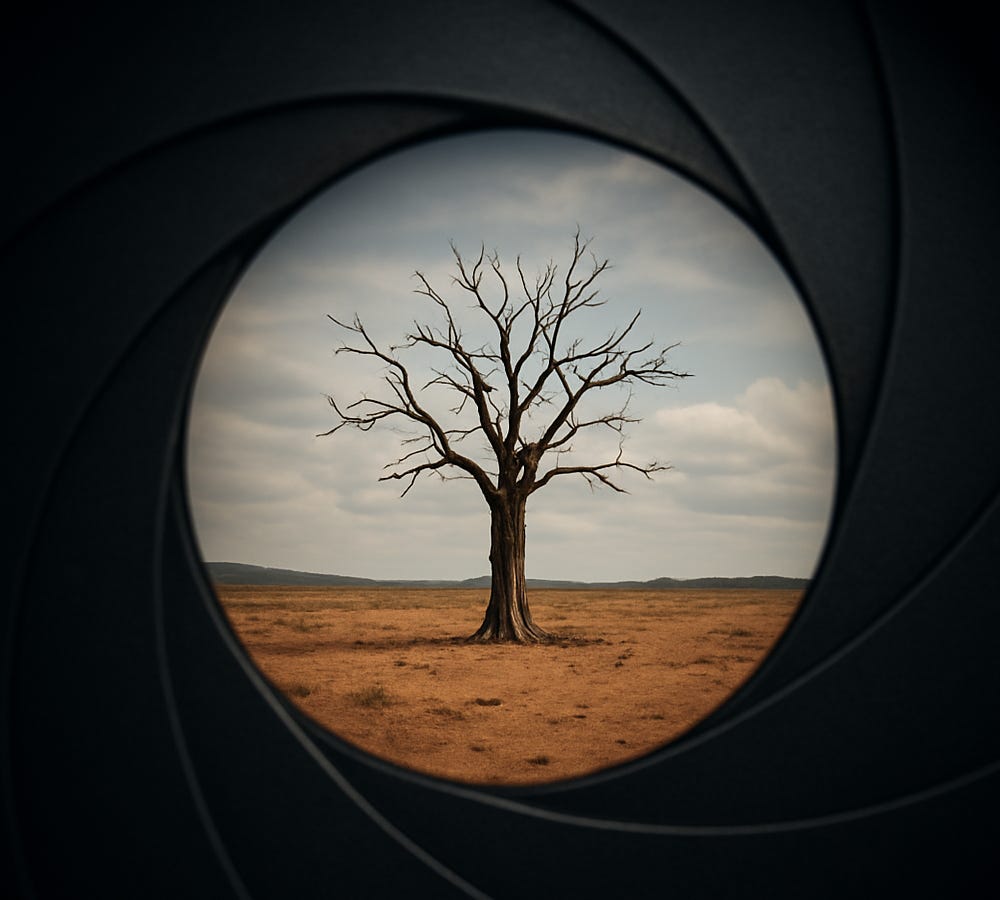
When the amygdala is active, it sends signals back to our sensory systems. This has a very real consequence: our perceptual “aperture” shrinks. In states of fear, our visual field literally narrows. We become hyper-focused on potential threats and blind to peripheral information.
In other words, fear doesn’t just feel constricting — it is constricting. The world seems smaller, harsher, and more dangerous, not because it has changed, but because our nervous system has tilted the lens.
Why the Brain Hates Uncertainty
The science is clear: our brains are prediction machines. They’re constantly scanning for patterns, trying to anticipate what will happen next so we can stay safe. From an evolutionary perspective, this narrowing was adaptive. If you were foraging and heard a rustle in the grass, it paid to focus on that uncertainty. It might have been the wind — or it might have been a predator. Better safe than sorry.
From Evolution to Modern Anxiety
But today, most of our threats aren’t physical. They’re mental: an email from our boss, the news about government gridlock, a worry about the future. The same biological machinery kicks in, but there’s no bear to run from, no fight to resolve. Instead, we get stuck with our nervous system switched “on,” sometimes for days or weeks.
Because the amygdala is so tightly interconnected with the rest of the brain, its activation can trigger a feedback loop. Fear alters perception, altered perception reinforces fear, and bodily changes (like increased heart rate and shallow breathing) further feed the cycle. This is why a small seed of uncertainty — a headline, a stray thought — can spiral into anxiety or panic.
Awareness as an Antidote
Here’s the good news: awareness itself changes the game. One study showed a counterintuitive finding: when people are exposed to fear signals they can’t consciously perceive (like a fearful face flashed too quickly to notice), the amygdala response is stronger and longer-lasting than when they do consciously perceive the same signal.
This suggests that awareness itself regulates fear. Becoming conscious of what’s happening—our tightening chest, our restless thoughts—we interrupt the loop, allowing the nervous system to settle more quickly. The aperture widens again. We see more clearly.
The Bottom Line
Uncertainty is inevitable — even trivial unpredictability activates the brain’s fear centers.
Fear changes perception — it literally narrows the field of awareness.
Awareness widens it again — noticing the contraction loosens its grip.
In other words: uncertainty is unavoidable, but blindness in the face of it is not. The more we understand how fear hijacks the brain, the more clearly we can see both the world — and our own minds.
As Richie puts it: awareness is the elixir.
Practice Prompts
Formal practice: Sitting down daily, even briefly, trains the brain to respond differently. Think of it as mental hygiene—like brushing your teeth. Try this 2-minute meditation on awareness sometime today or later this week.
Informal practice: In everyday life, pause and reflect when triggered. Notice what’s happening in the body. Try shifting from judgment to curiosity. Even small moments of reframing make a difference.

“When you sit down to learn to meditate, many people probably start with either meditating on the breath, doing mindful breathing or breathing with awareness or maybe a body scan. And it can feel so cut off from normal life. But actually what we're doing is we're training ourselves so that in these moments where our nervous system is activated, and we have these emotional reactions…We actually can not get so stuck and contracted and can and widen that.”
Cortland Dahl, DL Ep 6: The Science of Uncertainty
Reflection: How do you experience uncertainty in your daily life? And what helps you widen your perspective when everything feels constricted? Drop us a comment - we’d love to hear from you.
With gratitude,
Cort + Richie
🎧 Tune in later this week on the podcast for the full conversation. We’ll share stories and science around how uncertainty impacts our lives, and tools you can apply to yours.
Do you have topics you would like to see in future posts, suggestions for features, or areas of improvement? We would love to hear from you HERE!
I would like to see how to productively use self-reflection and how to prevent self-reflection from getting into overthinking.
If all certainty is fabricated, why does the brain treat particular or even irrational certainties as non-activating? What neurological process produces a state of homeostasis for some threats but not for others? Is it simply a matter of how immediate the threat appears?