


It’s now been about a month or so since Richie and I returned from Nepal. The trip was, for both of us, one of the most extraordinary and mind-blowing experiences we’ve ever had.
Some of you may have caught the live session we did shortly after we got back. If not, here’s a bit of context.
We traveled with a small group of scientists and friends—including our colleagues Sona Dimidjian, Elena Antonova, Nirosha Murugan and Martin Picard (whose Substack we highly recommend), along with Adam Weissman and Christina Glavas.
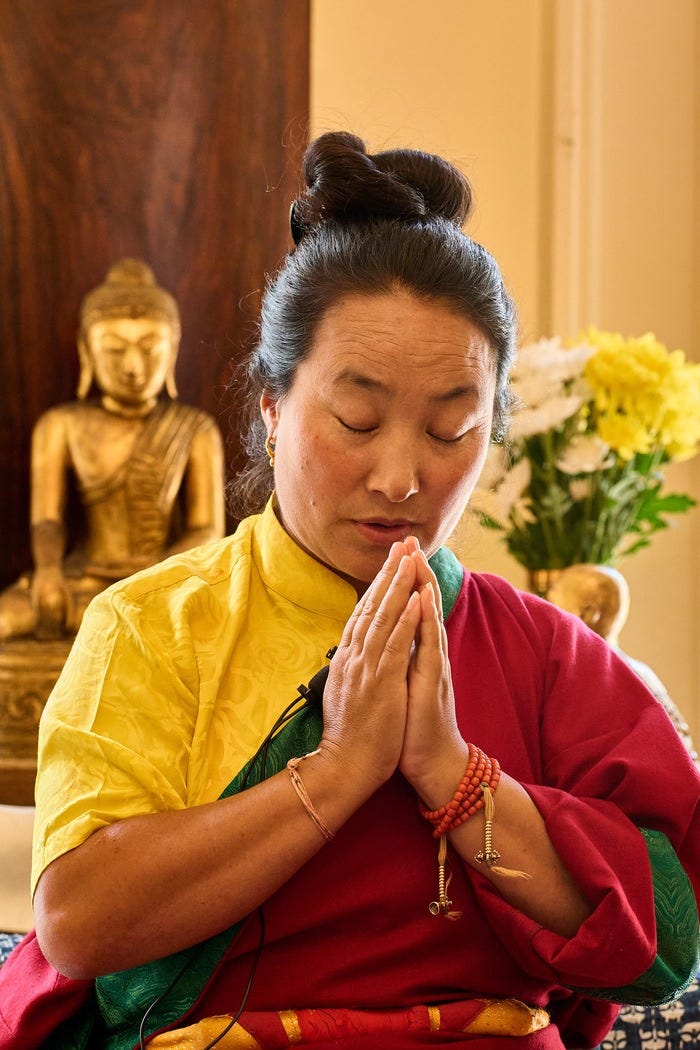
The purpose of the trip was to meet an eminent Tibetan lama, Khandro Tseringma Rinpoche.
Khandro-la, as she is often called, is one of the great living exemplars of the Tibetan tradition. And she is completely unique.
Why We Went
We were there for dialogue, but more than anything, we were there to listen.
The central theme of our time together was the possibility of enduring well-being—a kind of inner flourishing that isn’t fragile or dependent on circumstances, and doesn’t rise and fall with the constant movement of thoughts and emotions.
From a scientific perspective, this is almost unexplored territory. We have a growing body of research on happiness, stress, resilience, and even meaning and purpose. But the idea that well-being could be stable and enduring—that it could remain even as conditions change—is barely on the map.
So we went in with a very simple intention: to learn from her experience. Not to translate it too quickly into scientific frameworks, but to really listen, and see whether her perspective might help us begin asking better questions. Questions that could eventually shape research, but also speak more directly to the human condition—how we live, how we suffer, and what might actually be possible for us.
A Rare Opportunity
We had two full days with Khandro-la.
Our group of scientists was joined by an extraordinary group of Tibetan teachers, including Yongey Mingyur Rinpoche and Tsoknyi Rinpoche, along with scholars and a global audience of several hundred people who were simply there to observe.
And for those two days, we did something that is almost never done.
We listened to Khandro-la speak openly about her inner experience.
In the Tibetan tradition, especially among accomplished meditation masters, there is a strong norm, almost a prohibition, against sharing personal realizations in public. Typically, these kinds of experiences are only discussed with one’s teacher, or with a very small circle of close practitioners.
In fact, when someone speaks openly about their realization, it’s often taken as a sign that something is off.
But this was different.
At the direct request of His Holiness the Dalai Lama (who personally trained her), she agreed to share her experience openly.
That made this an incredibly rare opportunity: a chance to hear, firsthand, how a deeply realized practitioner understands her own mind.
A Childhood Unlike Any Other
Khandro-la was born in an extremely remote region of eastern Tibet.
To get a sense of what that means, imagine the most remote place you’ve ever visited—and then multiply that by a thousand. Tibet is remote to begin with, and this was an especially isolated area.
She grew up in a nomadic family. She had no formal education and no access to healthcare. None of the basic structures most of us rely on.
And yet, despite what might have looked like an impoverished upbringing, from a very early age her inner life was incredibly rich.
On the first morning, we asked her to describe her childhood, especially her inner experience.
She spoke for nearly three hours, covering the period from around age two or three up to seven.
What struck me immediately was the level of detail. The specificity of her memory was astonishing. It felt less like someone recalling early childhood and more like someone describing what they had done the previous day.
I could barely believe what I was hearing. I can hardly remember what I had for breakfast yesterday, let alone what I was doing at age three.
A Child Exploring Consciousness
But that wasn’t even the most striking part. What stood out most wasn’t the visionary or mystical content—though there was plenty of that. It was her curiosity. She came into this world with an intense, almost relentless interest in consciousness itself.
As a small child, she was already noticing things most adults overlook entirely. She was fascinated by how consciousness changes across the day—waking, falling asleep, dreaming, deep sleep—and she wanted to understand what was actually happening. For example, she wondered: what happens to visual consciousness when we fall asleep? Does it stop? Or is it still functioning in some way?
And she didn’t leave it at that. She ran experiments. At one point, she described sneaking up to her sleeping parents and holding a needle in front of their eyes, thinking that if visual consciousness were still active, they would react. We all had a good laugh imagining how badly that could have gone.
When nothing happened, she refined her thinking. Maybe visual consciousness is still present, but dormant behind closed eyelids. So she found someone who slept with their eyes slightly open and tried again. Still no reaction. From that, she concluded that visual consciousness doesn’t function at all during sleep, even if the eyes are open.
It’s both hilarious and kind of remarkable. A small child in a nomadic tent, running controlled experiments on consciousness.
Turning the Experiment Inward
But what came next was even more remarkable.
She shifted from observing others to observing her own mind.
Instead of testing what was happening in other people, she began closely tracking her own experience as she fell asleep.
This is not easy to do. Even experienced meditators often struggle to maintain awareness through that transition.
But she described it in detail.
She could see the gradual shutting down of the senses. The fading of sensory input. Then the emergence of more subtle mental activity—images, thoughts, dreamlike fragments.
And then, eventually, the disappearance of even those.
What remained was what she described as a kind of bare awareness—knowing, but without any object.
No sights. No sounds. No thoughts. Just awareness itself.
In the Tibetan tradition, this is often referred to as luminosity—pure awareness, or the most fundamental level of mind.
This is something that, in traditional settings, people spend years training to recognize, often in strict retreat.
And here she was, around six years old, accessing it directly, without any formal training or conceptual framework.
Just curiosity.
What This Points To
For us as scientists, this raises some important questions.
If this account is even partially accurate, it suggests that there may be aspects of consciousness—and potentially well-being—that are far more accessible than we tend to assume.
It also suggests that what we think of as well-being might be limited. We tend to define it in terms of emotional states—feeling good, reducing stress, increasing positive affect.
But what she was pointing to is something much deeper.
A form of well-being that isn’t dependent on emotional states at all.
Something stable. Something that doesn’t come and go.
And just as important was the method.
She didn’t arrive there through theory or belief.
She got there by looking.
Two Takeaways
If I had to distill this down, two things stand out.
1. The Far Reaches of Flourishing
Most of us are looking in the wrong place for well-being.
We spend our lives chasing experiences, trying to hold onto the good ones and avoid the difficult ones.
Even when we start meditating or engaging in some kind of spiritual practice, that pattern often continues. We just shift to chasing more refined or subtle experiences.
But it’s still chasing.
We’re still oriented toward something that isn’t here yet.
What Khandro-la was pointing to is a very different approach.
Instead of trying to improve our experience, we can examine the mind itself.
We can look directly at consciousness—at the process through which all experiences arise.
At a deeper level, there may already be a kind of stability and well-being that isn’t dependent on anything else.
The traditions talk about this—especially in practices like Mahamudra and Dzogchen—but what struck me here was how direct it was. How little it depended on elaborate methods.
2. Curiosity as a Practice
The second takeaway is more practical.
Curiosity, not as an abstract quality, but as a way of engaging experience, may be one of the key ingredients.
This isn’t curiosity in the sense of collecting information or developing theories.
It’s curiosity as direct observation.
Looking at experience as it unfolds:
Noticing how the mind shifts in different contexts
Paying attention to transitions—falling asleep, waking up, shifting between activities
Observing thoughts and emotions as they arise and dissolve
In that sense, we become investigators of our own experience.
Not in a detached, analytical way, but in a very immediate, experiential way.
Over time, this kind of observation can start to reveal layers of experience that we usually miss entirely.
A Personal Reflection
After that first day, something shifted for me.
Even after years of practice, I felt a renewed sense of interest.
There’s something surprisingly compelling about just watching the mind:
How different it feels in a social setting versus being alone.
How it changes when focused versus relaxed.
What happens in those in-between moments—falling asleep, waking up, switching contexts.
It’s all there, constantly changing, constantly revealing something—if you pay attention.
An Invitation
We can all explore our own minds in this way.
And this kind of exploration isn’t just interesting. It may actually change how we relate to our experience. It may help loosen some of the patterns that drive stress and dissatisfaction. And it may point us toward a deeper kind of well-being, something that isn’t dependent on getting the right conditions in place.
It’s only been a few weeks since we returned from Kathmandu, and I imagine I’ll be reflecting on this experience for a long time.
But I wanted to write some of this down while it’s still fresh, partly for myself, and partly in case something here resonates with you.
With appreciation,
Cort
P.s. If you’d like to read another account about our trip, check out this post by Martin and Nirosha, who accompanied us on the journey.
I'm reminded of Shunryu Suzuki Roshi's insistence that we not meditate "with a gaining idea." That we not engage in "stepladder Zen"--always reaching for some more advanced or higher state--a reaching that leaves us perpetually dissatisfied with our present flowing moment. It's a paradox. Would I meditate this morning if some part of me didn't anticipate some "benefit"--calmness, well being, thriving, happiness? Suzuki Roshi also commented that "If it's not a paradox, it's not true." Thanks for this fascinating account of the trip to Nepal.
Cort, thank you for sharing this. Feels like a door opening to space I wasn't aware existed in this moment.