


Every January, millions of people resolve to change.
We resolve to exercise more, eat better, meditate regularly, be less reactive, more present, more kind. These intentions are genuine — and yet most of them quietly fade within weeks.
This isn’t because people lack intention or motivation.
It’s because most New Year’s resolutions are based on a flawed model of how change actually happens.
Lasting change does not come from making stronger promises to the future.
It comes from training how we respond when familiar moments arise.
The Problem with Most Resolutions
Most resolutions are outcome-focused and future-oriented. They rely on willpower: “This year, I will…”
But they rarely specify what happens in the moments when habits are actually activated.
They also turn change into a self-evaluation project: Did I succeed or fail today?
When we fall short, the resolution becomes another source of discouragement — which often reinforces the very patterns we want to change.
What’s usually missing is structure:
What cue will trigger the new behavior?
What will I do in the exact moment the old habit appears?
How will repetition — not intensity — do the real work?
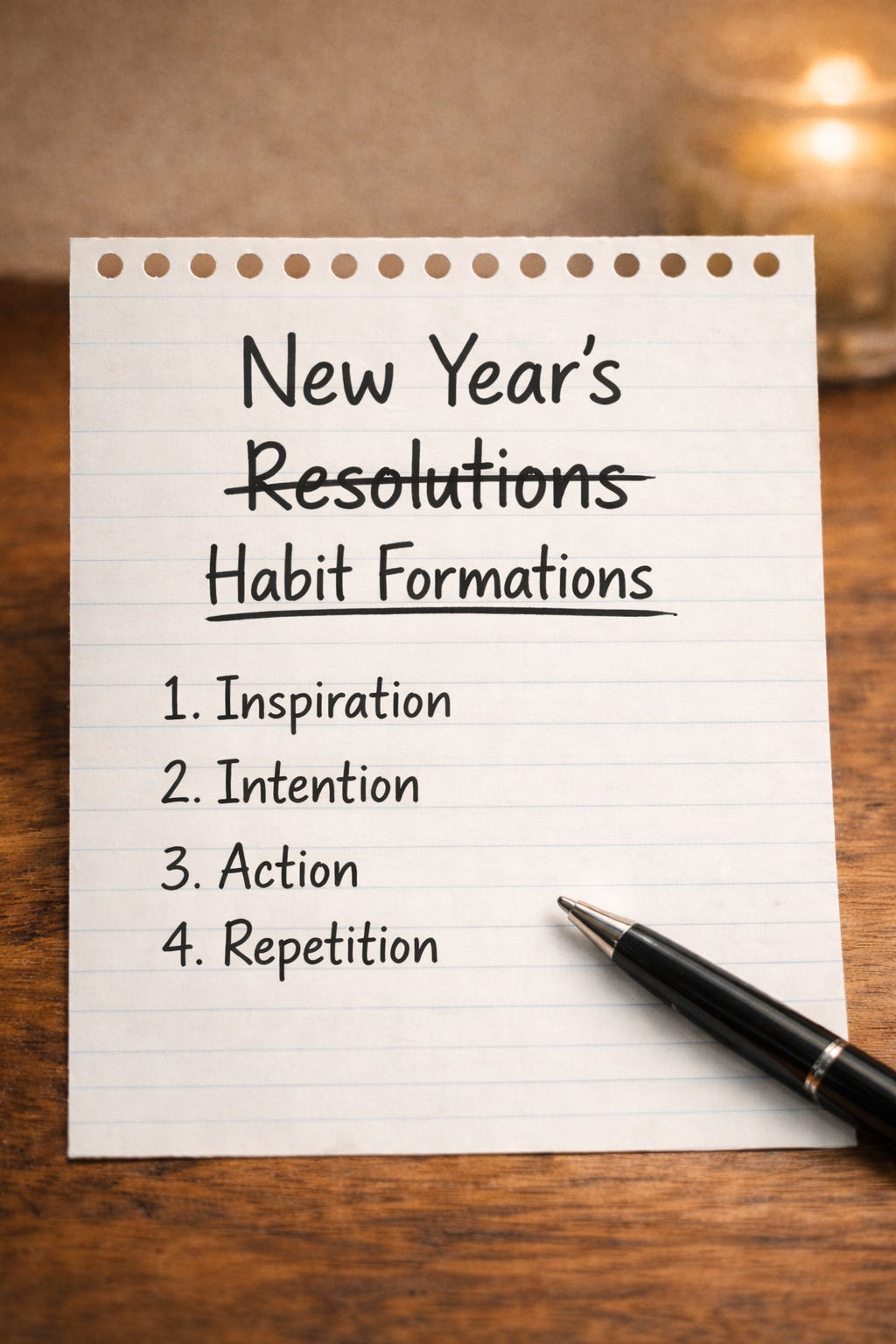
Flourishing Is Built Through Conscious Habits
In our upcoming book Born to Flourish (available for pre-order now, arriving March 2026), we describe a simple but powerful idea: flourishing is built through conscious habits.
Habits are typically automatic behaviors triggered by specific cues — times of day, emotional states, or familiar situations. What’s often overlooked is that we don’t have to accept the entire habit as unconscious.
Instead, we can select specific cues to be aware of and train our inner response to these cues to be intentional.
For example: sitting down to eat. We can select this as a cue for awareness and connection. When we sit down to eat, we intentionally bring our awareness to the act of eating and we connect to our sense of appreciation for all the people it takes to bring food to our plate, and to our sense of interconnectedness for the extraordinary range of people and activities that are required for us to be nourished.
In this way, the practice of awareness and connection when we sit down to eat becomes a conscious habit.
Rather than adding something new to an already busy life, we use the life we already live as the training ground.
The Four Steps That Turn Resolutions into Habits
Research on learning and habit formation points to four essential steps:
1. Inspiration
Change begins with inspiration—a clear sense of why a habit matters. Inspiration provides direction, but on its own it’s not enough.
2. Intention
Intention is the conscious decision to act in a certain way. Unlike automatic habits, conscious habits depend on intention—but intention can itself become automatically triggered by a cue.
For example, brushing your teeth can become a reliable reminder to pause and notice your breath, reflect on your emotional state, or cultivate gratitude. Or sitting down to eat can become a cue for awareness and connection, as we’ve noted. Psychologists and neuroscientists call these cues affordances. An affordance provides the conditions that allow a particular mindset to be activated.
3. Action
Action can be physical or mental.
A conscious habit might involve mindful awareness, appreciation, or compassion—inner actions that shape how we experience the moment.
4. Repetition
Repetition is the key. Research consistently shows that frequency matters more than duration, especially early on. Five minutes a day for thirty days is more effective than one long session once a week for cultivating the habits of flourishing.
Repetition turns intention into habit.
Memory Reconsolidation: Why Timing Matters
Neuroscience helps explain why this approach works.
Many habits aren’t just behaviors — they’re learned predictions. When a familiar cue appears—the sight of one’s workplace, the kitchen table in our home—the brain retrieves an old pattern: This is what happens next. And it may entail negative emotions that have been paired with this cue. If you experience stress at work, the sight of your workplace will elicit stress.
Research on memory reconsolidation shows that when a memory or habit is actively retrieved, it briefly becomes malleable. During this window, the pattern can be updated and transformed before it is stored again.
In practical terms, this means the moment a habit is triggered is not just a challenge—it’s an opportunity.
If, at the moment of retrieval, we introduce a different response—awareness instead of reactivity, kindness instead of criticism—the brain begins to encode a new association. Over repeated exposures, the old pattern loses its inevitability and healthy conscious habits begin to take hold.
This is why conscious habits are so powerful: they intervene at the precise moment when change is biologically possible.
Designing a Resolution That Actually Works
Instead of asking:
What do I want to achieve this year?
Try asking:
What habit do I want to train?
What is the inspiration for cultivating this habit? (inspiration)
What affordances already exists in my daily life that I can potentially harness? (intention)
What is the smallest inner action I can reliably repeat? (action and repetition)
A resolution becomes effective when it’s translated into:
inspiration → cue → intention → action → repetition

January can be a useful time cue—a moment to begin—but lasting change depends on what happens when the kettle boils, when irritation arises, when you sit down to eat, when you notice your mind wandering again.
A Short Practice: Reinforcing a Conscious Habit
This brief exercise uses intentional retrieval to strengthen a new habit.
1. Form an inspiration for why you wish to cultivate a particular conscious habit.
It could be that you are inspired to enhance your connection and prosocial skills since you wish to be maximally beneficial in helping others. Or whatever positive inspiration speaks to you.
2. Identify a familiar activity that occurs on a daily basis.
Form an intention to select an activity that you can work with. It could any one of the many activities we do every day such as eating, brushing our teeth, commuting, etc.
3. Act by bringing awareness to this activity each day.
It could be in very modest “doses” such as consciously being aware of brushing your teeth for three minutes or being aware of eating for the first few minutes of your meal.
4. Identify the quality you wish to cultivate.
It could simply be awareness itself, or it could be appreciation and interdependence, as the example above illustrates.
5. Memory retrieval and reconsolidation
When you encounter the familiar activity that you have chosen to work with (e.g., mealtime; brushing your teeth time), make a conscious effort to remember the feeling you had when you cultivated the positive quality you chose during the action. For example, if you cultivated appreciation and interdependence during mealtime. Say to yourself a phrase to help you such as: “I appreciate all the people it has taken to bring food to the table.” Use whatever phrase feels most comfortable to you.
This intentional pairing of the feeling state associated with your chosen quality and the memory of the daily activity itself will help to reconsolidate the memory as one that will promote flourishing, rather than whatever automatic associations you might have previously associated with eating.
6. Repetition
Do this every time you encounter the daily activity. You don’t need to do this perfectly. Each repetition strengthens the new pathway. Each encounter with the daily activity helps reshape the habit.
Flourishing doesn’t happen all at once.
It happens when small moments are met differently — again and again.
We wish you a new year of flourishing!
Richie + Cort