


Dear Dharma Lab Community—
One of the frameworks that quietly guides a lot of what we do here at Dharma Lab—both in our research and in our personal practice—comes from the Tibetan tradition. This three-part model—used for more than a thousand years in Tibet—helps us turn flashes of inspiration into enduring insights. In traditional language, it’s called view, meditation, and application.
View is about shifting perspective. Research on mindset shows that how we see the world shapes how we live in it.
Meditation translates those insights into direct experience. Studies show it can reshape both mind and brain in measurable ways.
Application means living those insights out — in conversations, chores, and everyday stress. We call these micro-doses of flourishing.
What Really Matters? A Meditation on View, Practice, and Everyday Life
We first started using this frame after a conversation with the Dalai Lama almost a decade ago. At the time, we were trying to figure out how to bring these ancient practices into the lab—how to study them with scientific tools without turning it into a lesson in Buddhist philosophy.
The Dalai Lama cut through all of that. He basically said:
“Forget the Buddhist stuff. That’s our business. What you need to do is take the meditative process and apply it to insights from modern science.” --Dalai Lama
That one sentence has shaped so much of our work since then. It’s also become one of the organizing principles for how we approach inner transformation—whether through science, tradition, or just the messiness of everyday life.
This week, we wanted to share how this frame—view, meditation, and application—can be used to explore one of life’s biggest questions:
What really matters most?
We talked about this in our first post, inspired by golfer Scottie Scheffler’s unexpected take on meaning and fulfillment. And it’s the focus of our first podcast episode too: what would the Dalai Lama say about what truly matters in life?
Here’s how we might walk through that question, using the view–meditation–application model.
1. View: A Shift in Perspective
Every journey starts with a shift in how we see. That’s what “view” means in this tradition—it’s not about having the right belief, but about opening up to a new way of looking.
This might be as simple as asking:
Am I spending my time on things that actually bring me joy or meaning?
What drives my decisions—and is it working?
Where do I find real fulfillment, even in the middle of stress or uncertainty?
This idea of a shift in perspective also maps beautifully onto one of the most important findings in modern science: mindset matters.
Our colleague Carol Dweck at Stanford has done groundbreaking work showing that having a growth mindset—believing that abilities and qualities can be developed—leads to all sorts of positive outcomes, especially in education.
Here’s a graph from one of her seminal papers, showing how a brief mindset intervention can change learning outcomes on hardnosed metrics like test scores (Math in this study) - you’ll see below that the outcomes for the Experimental group increased significantly with the brief interventions:
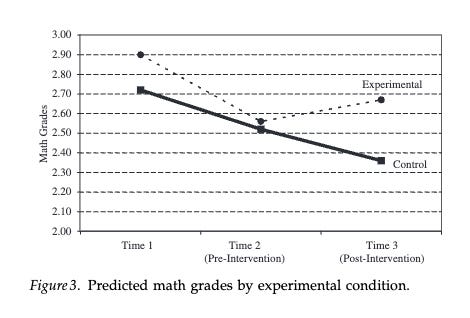
That research has been hugely inspiring to us. In fact, we’ve long had the hunch that many of the improvements we see in meditation interventions (like in our Healthy Minds Program) are at least partly due to shifts in perspective and mindset. It’s one of the next big areas we’re actively studying—and our early findings are pointing strongly in that direction.
2. Meditation: Turning Insight Into Experience
The next step is to take that shift in view and make it real—not just in your thoughts, but in your body, your breath, your moment-to-moment experience.
This is where meditation comes in.
Not as an escape. Not as a performance. But as a way of sitting with a question and letting it land.
For example, you might try sitting with:
What really matters to me, right now, in this season of my life?
Where do I already feel a quiet sense of meaning—and how can I listen to that more?
Here too, we’re standing on a strong scientific foundation. Across dozens of studies and data from hundreds of thousands of people, we’ve seen how meditation fundamentally changes how the mind works, and even how the brain functions—and physically changes—over time.
The science here is expanding rapidly. One exciting area we’ve been exploring is how different types of meditation—what we call the attentional, constructive, and deconstructive families—create distinct psychological and neurological effects.
So far, scientists have only studied a small handful of these practices. The field is just beginning to scratch the surface, and we’re incredibly excited to keep pushing into that frontier.
3. Application: Bringing It Into Everyday Life
Finally, we ask: So what? How does any of this show up when we’re unloading the dishwasher or replying to emails?
This is where practice gets real.
It’s not about changing everything in your life. It’s about bringing a new lens to the life you’re already living.
Washing dishes as an act of care
Holding a stressful moment with more spaciousness
Seeing errands or meetings as a chance to show up with purpose
We both do this in small, daily ways—folding laundry, walking the dog, setting the table. These don’t seem to be profound moments. But they can be, with the right shift in perspective.
And from a scientific point of view, this may be the most exciting frontier of all.
We tend to think of meditation as something we do on a cushion, in silence. But the future of these practices is out in the world. What if we could learn to drop brief “micro-doses” of awareness, insight, or compassion into our days?
We’ve seen early signs that these moments—brief as they are—can have a measurable impact on well-being, even physical health. We’ll be sharing more about this in our research soon, but we’re also eager to explore it together—with you.
In fact, we’re thinking about experimenting with a bit of citizen science here. Trying some simple practices together in everyday life and sharing what we notice. If you’re game, we’ll be inviting you to join us soon.
So, that’s the arc:
View → Shift your perspective
Meditation → Ground it in direct experience
Application → Live it in daily life
We’ll be coming back to this framework again and again. It’s one of those hidden keys that unlocks a lot.
And if it speaks to you, try playing with it this week.
Start with a simple question: What really matters right now, for me?
Let us know how it lands. We’d love to hear from you.
With appreciation,
Cort & Richie
Great article, thanks. Puts things into perspective. On the "View" aspect: the impact of 'mindset', or what we could also call belief has a lasting impact according to Blackwell and Dweck. As theories tend to sink into the subconscious where they become beliefs, they are not easily accessible, and so we experience it as natural that they have this lasting effect. (unless they are lifted into consciousness, discussed, and could undergo change). What the "View" section doesn't mention, is that the autonomous nervous system state, which varies throughout the day, also impacts the way we view and interpret the world. These states are variable (unless they get stuck by chronic stress, depression or trauma and event then...). Applied polyvagal theory teaches us that becoming more aware of these state fluctuations also helps us understanding our shifts in views, and further provides clues how to improve regulation and get back to safe and coregulation, and to our more positive views of the world. Of course, improved self-awareness is helped by step 2, meditation, and probably how we put it into practice into daily life. Now we have potentially an upward spiral.
Thank you for sharing this roadmap and perspective.I am curious here about the perspective of meditation. In the Theravada tradition my understanding is that meditation takes place in each of our actions--in what and how we are present-- mindful... and become the observer. Whether we are lying down, eating, walking, talking, etc. please help me understand how to connect this roadmap to observer, if appropriate?