


Some of the clearest wisdom I have read this past year didn’t come from an ancient Tibetan manuscript or a neuroscience journal. It came from a shareholder letter.
A few weeks ago, I found myself reading Warren Buffett’s final public message to shareholders. Berkshire Hathaway is a financial juggernaut valued at over $1T, and Buffett is the icon of capital accumulation, personally valued around $150B. You’d expect a man who has accumulated more wealth than most nations to talk about margins, markets, or the long game of compounding assets.
He did talk about the long game...just not the one played on Wall Street.
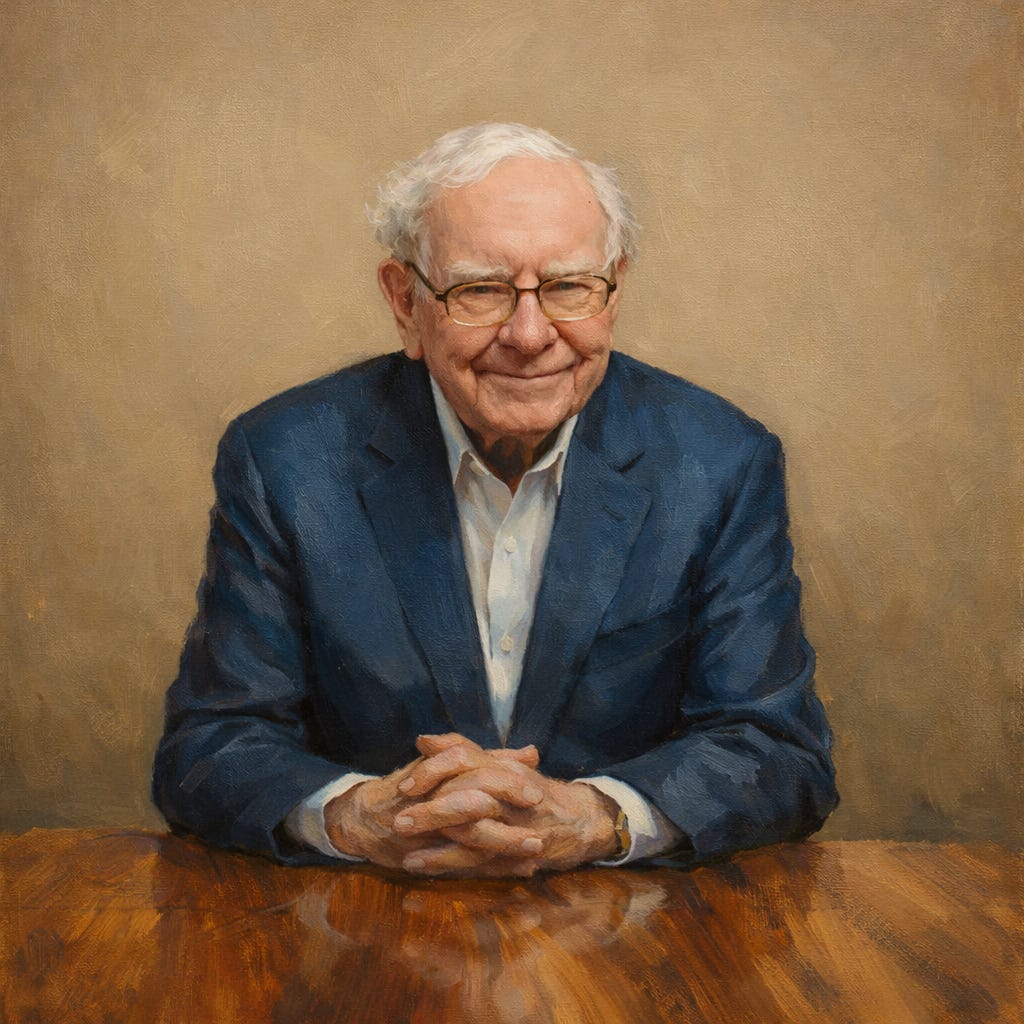
In a section that felt less like a CEO’s directive and more like a grandfather’s final testament, Buffett pointed again and again to the things that have nothing to do with money. He wrote about enduring friendships. He wrote about the good fortune of a loving community. And he wrote about kindness, which he called “costless but also priceless.”
He states:

There was nothing flashy in Buffett’s statement, but it was unexpected coming from him. Here’s a man who epitomizes wealth and the capitalist ethos of our era telling us that true wealth isn’t found in our bank accounts. It’s found in our relationships.
The ROI of Kindness
Buffett’s suggestion that we should shift our focus away from the accumulation of wealth and put more emphasis on relationships, community, and kindness echoes important insights from scientific research.
Our society is built on the deep-rooted assumption that lasting fulfillment comes from getting the things we want. We assume that if we get the right job, the right stuff, and the right relationship, we will finally feel content. But research paints a very different picture.
There is a fascinating body of work on the phenomenon of “prosocial giving” that flips this assumption on its head. In one famous set of experiments, researchers gave people a sum of money and divided them into two groups. One group was told to spend the money on themselves; the other was told to spend it on someone else.
Consistently, the people who spent the money on others reported significantly higher levels of happiness than those who treated themselves.
This isn’t just a psychological quirk; it is wired into our biology. Neuroscientists have found a striking overlap between the brain’s “care network” (used when we nurture others) and the “reward network” (which processes pleasure and motivation). When we extend care to a friend or stranger, our brain lights up in many of the same regions that activate when we experience a burst of positive emotion.
In other words, we are biologically designed to find fulfillment in service.
Buffett, in his ninety-fifth year, is pointing us toward this biological reality. Working for the greater good and nurturing our relationships isn’t just “nice” to do; it is deeply nourishing for the doer. The science backs up his core assertion: kindness is indeed priceless. Its benefits for our physical health, emotional well-being, and ability to flourish are greater than almost anything else we can acquire.
The Cost of a Global Life
Buffett’s focus on friendship struck a chord for me at a very personal level. I grew up in the Midwest, not far from Omaha, where the values were quiet and the summers in the Boundary Waters taught me that wisdom is rarely loud.
But for much of my twenties and thirties, I traded those roots for a global journey. I spent time in more than forty countries and lived for nearly a decade in India and Nepal, translating ancient meditation manuals and meditating in isolated hermitages in the foothills of the Himalayas. I met extraordinary teachers and had experiences that completely redefined my understanding of our potential as human beings.
I wouldn’t trade those years for anything, but there was a cost.
A life of movement does not lend itself to a life of rooted relationships. I remember moments of profound loneliness, realizing that while I was deepening my spiritual journey, I was neglecting the compounding interest of deep, long-term friendship. It took me years to recognize that spiritual practice isn’t just about what happens on the meditation cushion; it’s about the web of relationships we hold off the cushion.
Buffett lived a global life, yet he stayed anchored in Omaha. He kept his priorities where they belonged. He understood that similar to money, relationships compound exponentially.
Depth Without Complexity
We often confuse “depth” with “complexity.” We think that to find meaning, we need esoteric practices, complex neuro-hacks, or a total life overhaul.
But here is the “Sage of Omaha” reminding us that the truly important things in life are actually quite simple.
Be kind
Nurture your friendships
Build community
The truth is not complicated. It is just easy to overlook because it doesn’t scream for our attention.
A Practice for This Week: The Kindness Micro-Investment
If we take Buffett’s advice seriously—that kindness is the most valuable asset we could ever possess—how do we apply this?
We don’t need grand gestures. We need high-frequency trades.
Try this “Micro-Investment” today:
Identify one person who has contributed to your life but whom you haven’t thanked recently. It could be a mentor from ten years ago, a parent, or the barista who knows your order.
Send a “costless” text or note. Keep it simple: “I was just thinking about you and realized I never said thank you for [X]. It meant a lot to me. Hope you are well.”
Notice the ripple effect. As you hit send, notice how kindness actually feels. Do you feel a slight warmth in the chest? A softening in the shoulders? Take a moment to savor how nourishing kindness feels as it ripples through your mind and body, and out into the world.
That sensation is the dividend. It is the immediate, biological feedback of a life well-invested.
Buffett is right. Kindness costs nothing. But the inner wealth it brings? Priceless.
Warmly,
Cort
From the Archives:


Happiness has a lot to do with appropriate allocation of resources, especially time and attention.
It's not surprising that one of the world's great capital allocators knows a thing or two about allocating for happiness.
I'm reminded by this of how I and many of my "hard practice" friends who worked with Shunryu Suzuki in San Francisco and Katagiri Roshi here in Minneapolis did a real disservice to their spouses and children in their pursuit of Unsurpassed Complete Perfect Enlightenment. Children and spouses need kindness more than Enlightenment-seeking but often emotionally and physically absent mothers and/or fathers. Family practice? How square that circle?