


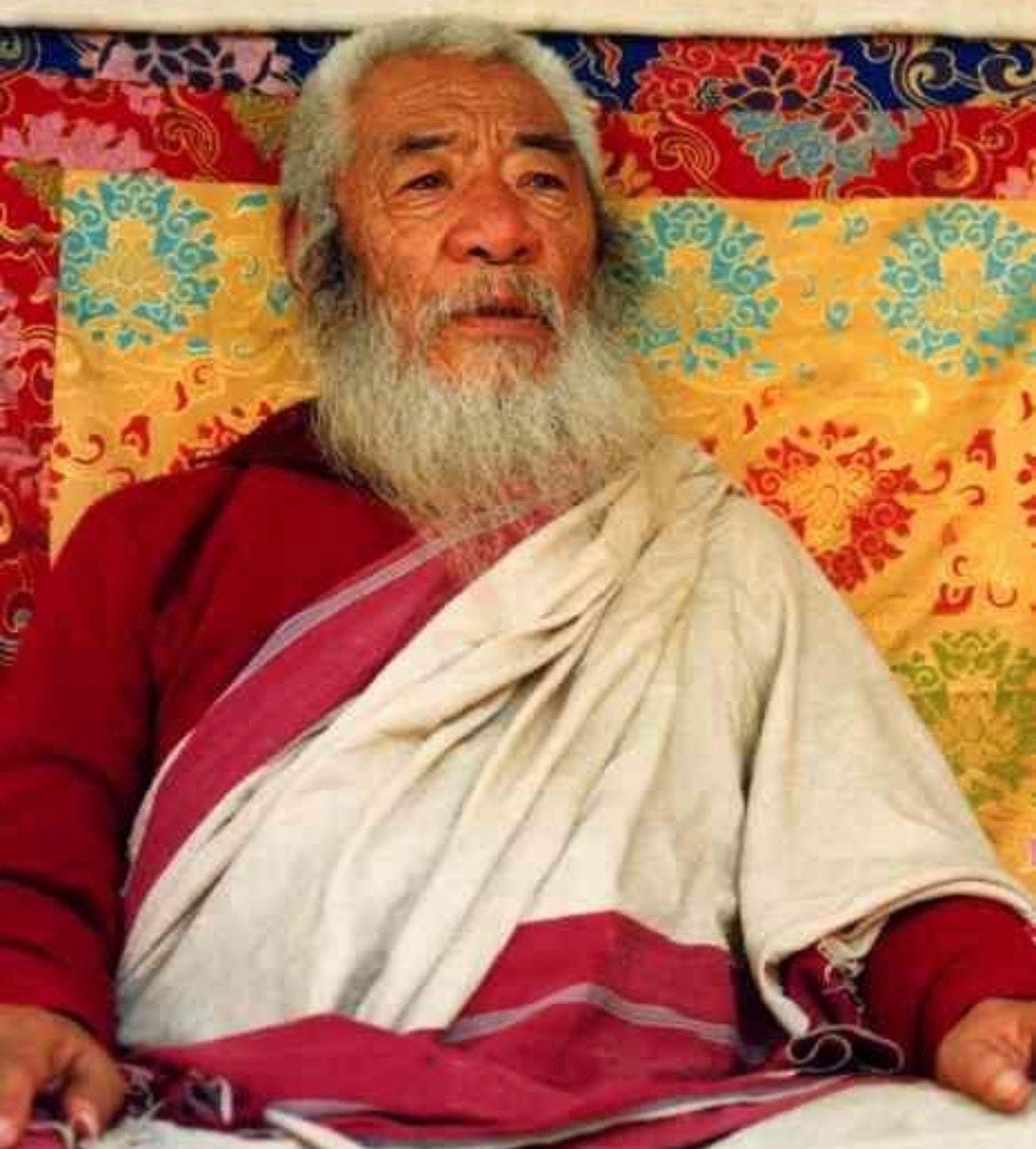
One of my first teachers, and one of the greatest inspirations in my life, was a reclusive Tibetan hermit named Chatral Rinpoche. He was widely regarded as one of the great meditation masters of his generation. For decades, he wandered the Tibetan plateau, meditating in caves, living in isolated hermitages, doing just about everything he could to avoid wealth, fame, and pleasure…the very things most people spend their lives chasing.
He was known not only for the depth of his realization, but for his extraordinary compassion. He lived with almost nothing. People would travel from all over the world to meet him and make offerings, but he never used those resources for himself. Instead, he would save them and use them to free animals that were about to be killed. He bought goats destined for ritual slaughter. He traveled long distances to fishing ports near Calcutta, where he would purchase thousands of freshly caught fish and release them back into the ocean. He was a strict vegetarian and spoke constantly about the suffering of animals, insisting that compassion must extend beyond human life.
An Unlikely Meeting
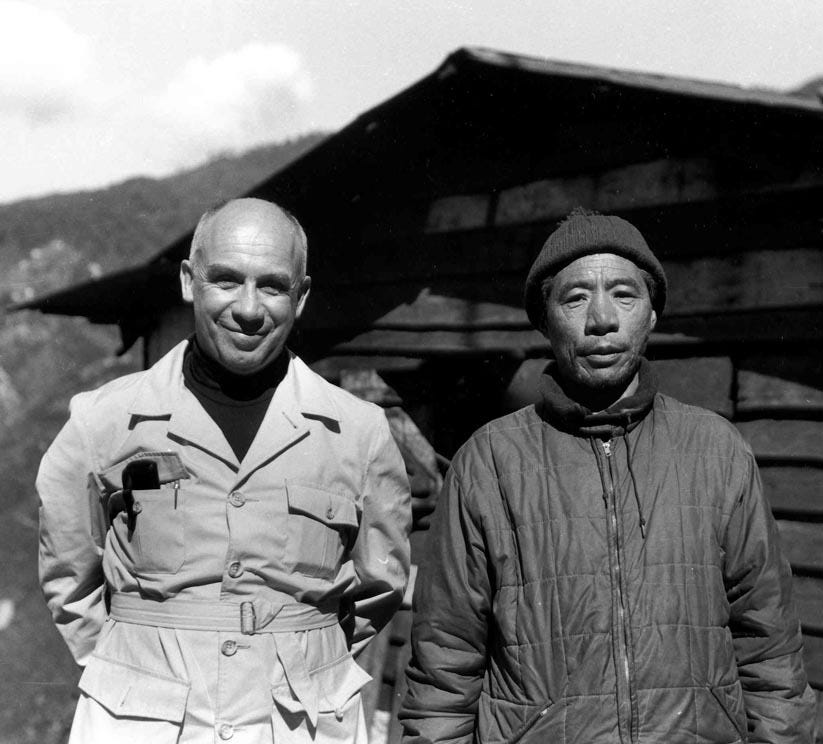
One of the most striking stories I heard about him involves an unlikely connection with the Christian Trappist monk Thomas Merton.
Merton isn’t as widely known today, but in the 1950s and 60s, he was a towering figure in the modern spiritual landscape. He helped revive contemplative practice within Christianity and traveled extensively to meet teachers from other traditions. During his time in Asia, he met many of the great Tibetan masters who had fled their homeland.
After meeting a number of these teachers, he eventually connected with Chatral Rinpoche. By all accounts, this meeting was different. Merton felt he had found his teacher. He planned to return to Asia to study more deeply with him.
But he never got the chance. He died suddenly in Bangkok, electrocuted in a tragic accident.
Still, before his death, there was a series of conversations between these two men—two deeply committed contemplatives from very different traditions—sharing their inner experience. What an amazing conversation that must have been. Two masters of their respective traditions, two lifetimes of inner exploration, shared in a deep, intimate conversation.
We don’t know exactly what was said. But according to some accounts, Chatral Rinpoche gave Merton the name Rangjung Sangye, which translates roughly as “self-arisen Buddha.” However we interpret that, it suggests Chatral Rinpoche felt that Merton had reached levels of awakening described in the Buddhist tradition.
One Mountain or Many?
That story has stayed with me for years, because it points to a question that sits at the heart of meditation practice:
Are there many paths up a single mountain? Or are there many mountains?
Do the world’s contemplative traditions lead to the same realization, described in different languages? Or do they lead to fundamentally different insights into the nature of mind and reality?
This question shows up even within Buddhism.
Are the different lineages and teachings pointing to the same awakening, or are they mapping distinct destinations?
To even begin answering these questions, we have to get clear on what we mean by awakening. At its most fundamental level, awakening suggests a radical shift in the way we experience ourselves, our minds, and the nature of reality. This isn’t about adopting a fresh set of beliefs or a new philosophy, but rather a profound transformation in perception—one that fundamentally alters our relationship to our thoughts, our emotions, and the landscape of human suffering. Yet, the moment we attempt to pin down this transformation, things get complicated, as various traditions map this inner terrain in strikingly different ways and some important questions emerge:
Is awakening something we already are, a matter of discovering qualities that have been there all along? Or is it something we become, the result of gradually purifying the mind and cultivating qualities like wisdom and compassion?
Is awakening about connecting to something beyond us? Does it somehow involve a divine force or higher reality? Or is it about recognizing something within our own experience?
I don’t have any definitive answers here. But I think these are questions worth exploring. And not just philosophically, but also experientially.
From a scientific perspective, we’re only beginning to scratch the surface of these age-old questions. There are early efforts to study advanced meditation states, but the terrain is vast, and the tools are still crude relative to the subtlety of the mind.
So for now, I’ll stay within the domain I know best: Buddhist contemplative traditions. Even here, the diversity is striking.
Pure Awareness
In certain strands of the Tibetan tradition, awakening centers on what is called rigpa, a Tibetan term pointing to pure nondual awareness. The idea is that there is a level of open, clear, luminous awareness present in every moment of experience, including sleep, dreaming, and states of apparent unconsciousness. Awakening, from this view, is not the achievement of some new state. It is what happens when you have recognized this awareness so thoroughly, and grown so familiar with it, that you never lose sight of it. Not just in meditation, but in the middle of a conversation, a strong emotion, or an ordinary afternoon.
One way this is described is as the union of samsara and nirvana. In some Buddhist frameworks, samsara, the cycle of suffering and dissatisfaction, stands opposite nirvana, its cessation. But from the rigpa view, they are not opposites. Nirvana is nothing more than being fully in touch with pure awareness, so completely that it pervades every experience without exception. You are in the world but not caught by it. The final state of awakening is not a particular state of mind. It is the recognition that pure awareness is the true nature of every state of mind.
Richie did some of the earliest research in this area, studying advanced meditators like Mingyur Rinpoche and looking for the neural correlates of what practitioners describe as open, effortless awareness. The science is young, but there are some fledgling efforts to study this form of meditation practice.
Cessation
A very different picture of awakening emerges from the Theravada tradition, common in Sri Lanka, Myanmar, and Southeast Asia. Here, the key term is cessation: a complete stoppage of ordinary experience, and even of refined meditative experience. There are no thoughts, no emotions, no sensory input, no meditative consciousness of the kind found in deep absorption states. It’s a complete gap.
The path that leads there involves refining attention to a high degree, combined with penetrating insight into the nature of experience. One description is that experience begins to pixelate. The normal flow breaks down into flickering moments, each one conditioning the next, and the whole process suffused with a sense of dukkha, unsatisfactoriness.
This is not the union of samsara and nirvana. Nirvana here is the end of samsara. Cessation is the moment when the stream of conditioned consciousness is severed for the first time. The point is not integration with everyday life. The goal is not to bridge this experience into the kitchen or the office. The path ends in the cessation of ordinary experience, not its transformation.
The felt quality of the path reflects this. Where rigpa practices emphasize space, openness, widening the aperture of awareness as wide as it can go, the Theravada insight path involves precise, penetrating attention to impermanence, change, and the conditioned nature of everything that arises. The practice is all about zooming in, not out.
There has been a small amount of research on cessation states in advanced meditators, attempting to locate neural correlates of these gaps in experience. It’s early work, but there are preliminary studies underway.
Stability and Absorption
A third domain worth mentioning is shamatha, sometimes translated as calm abiding or tranquility. This is the broad category of practice that includes contemporary mindfulness, where you rest attention on a focal point like the breath and return to it each time the mind wanders. Gradually, attention stabilizes. Periods of presence extend.
At the advanced end of the shamatha spectrum sits what is now a fairly popular topic in meditation circles: jhana practice. Jhanas are the deep states of absorption found in a number of Buddhist lineages, but most widely practiced in the Theravada tradition. In the early stages, the mind becomes highly concentrated on an object, often the breath. This shifts to absorption in a mental image or inner experience, sometimes described as inner light or sound. Eventually even these inner objects fall away, leaving refined states that are difficult to describe if you haven’t encountered them.
Both the Tibetan and Theravada traditions acknowledge these states without treating them as awakening. Some teachers are genuinely skeptical of them, since the bliss and tranquility of deep absorption can become an end in themselves, a pleasant cul-de-sac. Every tradition agrees that some degree of stability is necessary, but they disagree about whether advanced absorption states are required, helpful, or even counterproductive.
What’s especially striking is how different the phenomenology is across traditions. In the rigpa-oriented approach, shamatha involves widening awareness, not narrowing it. You might use the breath as a support, but the intention is not to restrict attention to a single point. The point is to let awareness become panoramic, open, effortless. Thoughts and emotions can move freely without disturbing the quality of presence. In this style of practice you hear a lot about “open awareness” and “effortless presence.”
In classical jhana practice, the movement is in the opposite direction. The field of attention narrows. Thoughts slow and stop. The senses recede. There is a stillness like being at the bottom of a deep ocean, knowing the surface is there but feeling entirely separate from it. Some describe a state where even the connection to inner experience eventually becomes very fine and subtle. And then, in some cases, even that drops away.
Cliff Saron and his team did important early work in this area, studying meditators over extended retreat periods in what became known as the Shamatha Project. More recent research has followed as well, but research on this fascinating body of practice is still very early.
At the Edge of Understanding
Science is just beginning to explore these differences. Early studies—some of Richie’s work with advanced practitioners, as well as projects like Cliff Saron’s Shamatha Project—offer hints, but we’re still at the edge of what can be measured.
So where does this leave us?
If we return to that original question — is there one mountain or many? — we’re left, at least for now, without a clear answer.
What we do see is a landscape of extraordinary richness. Different maps. Different paths. Different descriptions of what lies at the summit.
And then there are moments like the meeting between Merton and Chatral Rinpoche, an intimate dialogue between two practitioners from entirely different worlds, recognizing something in each other that transcends those differences.
What a wonderful and mysterious journey.
Warmly,
Cort
P.s. We would love to hear your reflections on these questions. What path resonates most with you? And what is it about this path that draws you in? Please share your thoughts and experience in the comments below.
Very concise overview Cort, thank you. I was always interested in finding the ultimate bridge between traditions. I was raised as a Christian, then very interested in other traditions and philosophies, including Tibetan budhism and Zen, Advaita vedanta, Stoics, Confucionism, Taoism etc. At this moment i have an instinctual feeling that regardless of the tradition and local culture, wether theist on non theist the expanse of conciousness we connect to could be the same when we remove all concepts.
I've heard HH the Dalai Lama say that there are so many religions because there are so many different types of people. There are also many different types of Buddhism that, as a Buddhist, I believe are authentic, so it only makes sense that there are non-Buddhist systems leading to genuine realisation. Your example of Thomas Merton being a prime one. Any system that combines some reasoning and contemplative practices is worth a look, in my opinion.