


Welcome to our Seminal Research Series. Each installment takes one landmark study from the Center for Healthy Minds and puts it in context: where it came from, what it found, and how it helped shape the field of contemplative science.
We start with two papers that, taken together, gave the entire field of contemplative science a common language.
Back in 2011, Richie and I sat down for lunch with our colleague Antoine Lutz at La Brioche, a small French cafe that’s just down the street from the Waisman Center for Brain Imaging in Madison, Wisconsin, where Richie’s lab was based at the time. I was about to move to Madison to begin my PhD. Richie and I had been talking for a while about what that collaboration might look like, and Antoine, our dear friend and a brilliant neuroscientist who had worked closely with Richie for years, was part of that early conversation.
At the time, mindfulness was beginning to take off in a serious way, both in scientific research and in popular culture. The word was appearing all over the place, from corporate wellness programs to the pages of mainstream magazines. A lot of that momentum traced back, in no small part, to the pioneering work Richie and Antoine had done together a decade earlier. Their research helped establish meditation as a legitimate subject of scientific inquiry. And now the field was growing fast.
Over lunch, we started asking, “What’s next?” This question spurred a dialogue that lasted years and catalyzed some of our most important work together.
As we discussed where the field might go next, Richie mentioned something the Dalai Lama had said to him years earlier, a challenge that had stayed with him ever since. His Holiness had urged Richie to study not just the negative states that meditation might reduce, but the positive qualities it could cultivate. Compassion. Wisdom. Deep states of concentration. Forms of practice that didn’t map neatly onto the mindfulness label that researchers had been using. In particular, he mentioned a very specific form of meditation from the Tibetan tradition known as “analytical meditation.” This was nowhere on the map of scientific research at the time.
That’s when the problem became clear. The scientific field had been studying “meditation” as though it were a single thing. But anyone who had spent time in a traditional contemplative setting knew better. Focused concentration practice is not the same as open awareness. Loving-kindness meditation works very differently from analytical inquiry into the nature of the self. The Tibetan tradition alone contains hundreds of distinct practices, each with its own method, aims, and distinct benefits.
Scientists had no framework for making sense of this diversity. And without a framework, progress would be slow and confused. Researchers would keep comparing apples to oranges, using the word “meditation” to refer to practices with fundamentally different mechanisms and goals.
By the end of that lunch, we knew one of the first things we needed to do was create a map for the vast terrain of contemplative practices.
Paper One: Attention Regulation and Monitoring in Meditation (Lutz, Slagter, Dunne, and Davidson, 2008)
Our work built upon an important paper from four years earlier, back in 2008. Attention Regulation and Monitoring in Meditation was published in Trends in Cognitive Sciences and authored by Antoine Lutz, Heleen Slagter, philosopher and eminent Buddhist scholar John Dunne, and Richie. This was the first paper to introduce a distinction that has since become standard in the field: the difference between Focused Attention meditation (FA) and Open Monitoring meditation (OM).
These aren’t arbitrary categories. They reflect a genuine difference in what the practitioner is actually doing, and therefore in what the brain is likely doing as well.
In Focused Attention practice, you select an object, typically the sensations of breathing, and place your attention there. When the mind wanders, you notice, release the distraction, and bring it back. Over time, attention stabilizes. If you stick with the practice long enough, amazing things happen. Advanced stages of concentration that are unimaginable until you’ve experienced them. Profound states of inner stillness that are at once both healing and nourishing. States of bliss and ecstasy that you can access at will. Attention so fine-tuned that you can tune in to the most subtle sensations in your body, and the most subtle aspects of your mind. Simple in description, yet genuinely demanding in practice. The paper mapped the cognitive cycle that every meditator knows from the inside: sustaining focus, detecting distraction, disengaging, redirecting. Each of those steps corresponds to identifiable neural systems, and training them systematically is what FA practice does.
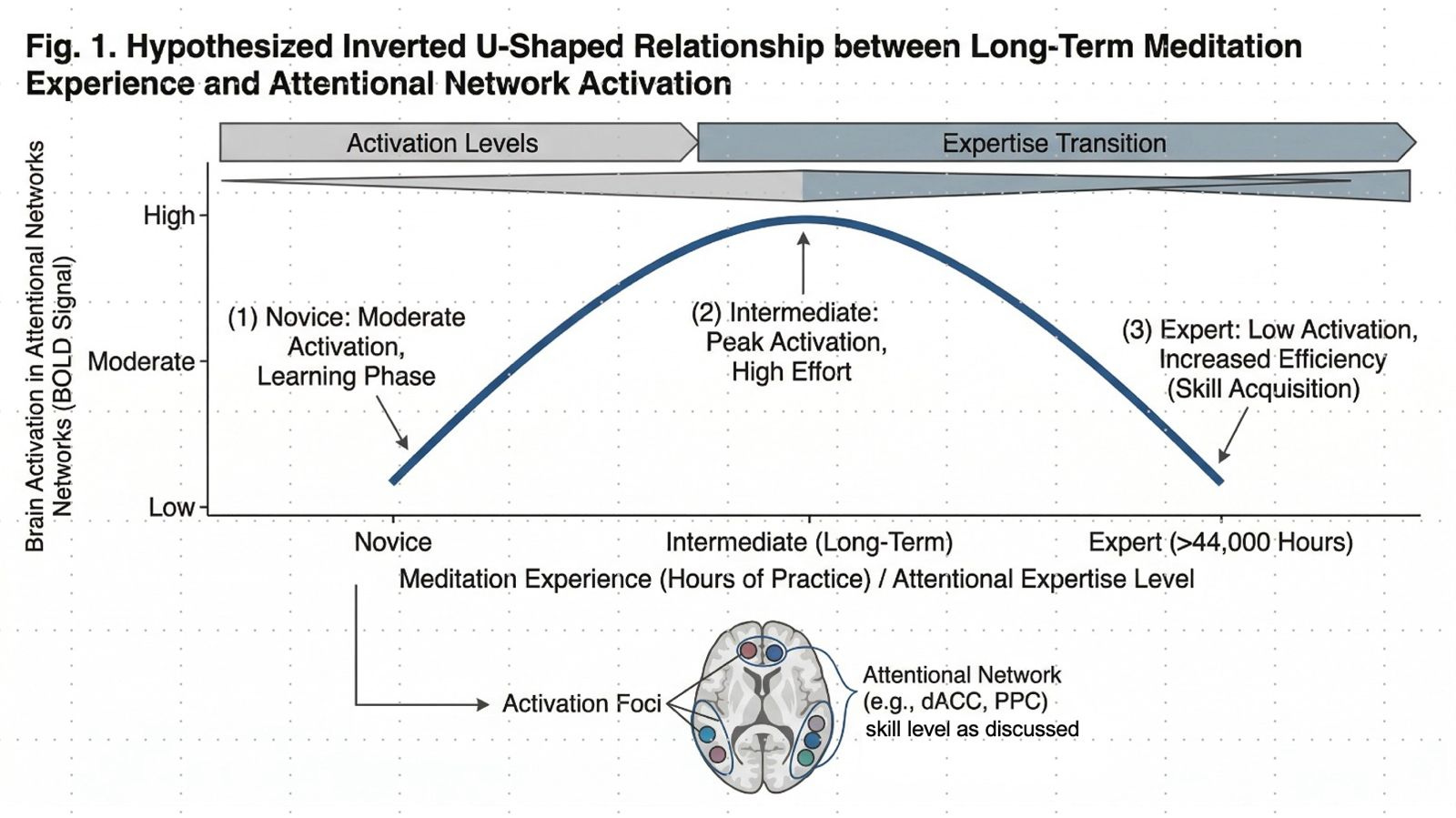
What the research showed was that this isn’t a matter of willpower. It’s skill acquisition. fMRI studies of long-term practitioners found that brain regions associated with attention monitoring and engagement were activated during FA practice. But they also found something unexpected: an inverted-U-shaped curve. Meditators with moderate experience showed more activation in these regions than novices. Highly experienced meditators showed less. The same pattern you see in any domain of expertise, whether language learning or playing an instrument. Effort decreases as skill consolidates. What begins as effortful concentration eventually becomes what the paper calls “effortless concentration.” The tradition had described this for centuries. Here was a neural signature for it.
Open Monitoring (OM) is a whole different animal. Rather than anchoring attention to a single object, the practitioner allows awareness to remain open to whatever arises – including thoughts, sensations, sounds, emotions – without selecting any of it as a primary focus. As Richie and I often say, “open the aperture of awareness.” You just open the mind as wide as it will go and rest in a state of relaxed, effortless presence. The monitoring faculty itself becomes the practice. What you’re training is the capacity to observe the stream of experience without getting swept into it.
The neural predictions follow from this. OM practice shouldn’t rely heavily on the systems that sustain and engage attention toward a specific object. It should rely more on the systems involved in monitoring, vigilance, and the ability to disengage from whatever captures attention. Studies bore this out. OM practitioners showed stronger performance on tasks requiring sustained, distributed attention and enhanced capacity to avoid getting “stuck” on any single stimulus, a phenomenon called attentional blink, which intensive OM practice was shown to reduce. There are all sorts of real-world applications of this skill, situations where being hyper-focused, or distracted, is counter-productive. This includes everything from driving to work to hanging out with friends. Most of our life calls for this kind of open, relaxed awareness.
The paper also documented something that practitioners often report but that science had rarely confirmed: changes in the baseline state of the brain. Long-term meditators showed elevated gamma-band activity (high-frequency brain oscillations linked to creativity and bursts of insight). And they showed this activity not just during meditation, but before it. The practice had altered the baseline activity of the brain itself. This was one of the earliest pieces of evidence that meditation doesn’t just produce temporary states. With sufficient practice, it produces traits.
Paper Two: Reconstructing and Deconstructing the Self: Cognitive Mechanisms in Meditation Practice (Dahl, Lutz, and Davidson, 2015)
The 2008 paper had given the field an important tool and it had an enormous impact. The FA/OM categorization is widely used in scientific papers to this day, and this paper is one of the most highly cited papers in the entire field of contemplative science.
The FA/OM distinction was an important step, but it still covered only part of the terrain. FA and OM, both forms of attentional training, represented two ends of a spectrum found in one broad category of contemplative practice. But there was more. A lot more. There were other practices that had entirely different methods and objectives, a vast range of meditation practices designed not just to stabilize attention but to actively reshape how we understand ourselves and relate to others. These were not yet on the map.
