


Hey friends —
Welcome to our first Dharma Lab Research Update!
One of the things we’re most excited about is sharing the coolest and most impactful research in the fields of contemplative science, cognitive psychology, social neuroscience, and the science of human flourishing. Our updates will cover a range of insights—from fresh new studies that spark immediate conversations among us, to foundational "greatest hits" research that continues to guide and inspire our work.
We're particularly passionate about studies with practical, real-world implications—research that extends beyond the laboratory and directly impacts our daily lives. To kick things off, we're sharing a classic study that's become one of our go-to references. It holds profound relevance in today's world, where our attention spans seem to be shrinking by the day.
To highlight just how relevant this research is, think about how often you catch yourself drifting mid-task or reaching for your phone without even realizing it. Let's dive deeper into a study that fundamentally changed our understanding of attention and well-being.
A Wandering Mind is an Unhappy Mind
The study is called A Wandering Mind Is an Unhappy Mind by Matthew Killingsworth and Dan Gilbert, published in Science back in 2010. And though it’s now 15 years old, the findings feel more urgent than ever—especially through the lens of what we now know about the brain, emotion, and human flourishing. This study has been cited more than 4000 times in scientific papers since it was first published.
In this groundbreaking study, over 2,000 adults from all walks of life were randomly pinged throughout their day and asked three straightforward yet profound questions: What are you doing? How are you feeling? Are you thinking about something other than what you’re doing? The results were eye-opening.
Key Finding: 46.9% of the time, people were not thinking about what they were doing.
Emotional Cost: People were consistently less happy when their minds were wandering—even when drifting to pleasant thoughts.
A World of Distraction
When this study was first published, the iPhone had just launched and social media was still new. Today, distraction isn't just common; it's our baseline. Our attention has become even more fragmented, underscoring the urgency of understanding and addressing our wandering minds.
Attention isn’t just passive—it shapes our brain’s structure, emotional regulation, and even our immune and cardiovascular systems. From a neuroscience perspective, attention is a powerful lever for well-being. When we hone the skill of keeping our minds calm and focused, for instance, we are not only strengthening the brain’s attentional network, we are activating the Central Executive Network, a constellation of brain regions that are engaged during many forms of self-regulation, including the process of managing emotional reactions, impulses, and unruly thoughts.
More Detail on the Study
Killingsworth and Gilbert's work showed even when people’s minds wandered to pleasant topics, they weren’t significantly happier than when they were present. And when minds wandered to neutral or unpleasant topics? Happiness dropped off a cliff.
Take a look at the image below, pulled directly from their paper. You can see in the bottom bubble that "not mind wandering"—in other words, being present and aware of what you're doing—is further to the right. That horizontal scale indicates levels of happiness. So, with the exception of making love (far right), nearly every form of mind wandering is, at best, slightly less happy than simply being present. And this holds true for every single activity, again, except for fun time in the bedroom.
The take-home is pretty clear: the best-case scenario when your mind is distracted is roughly equal to the worst-case scenario when you are present. The data shows pretty convincingly that mind wandering is rarely beneficial and often harmful.
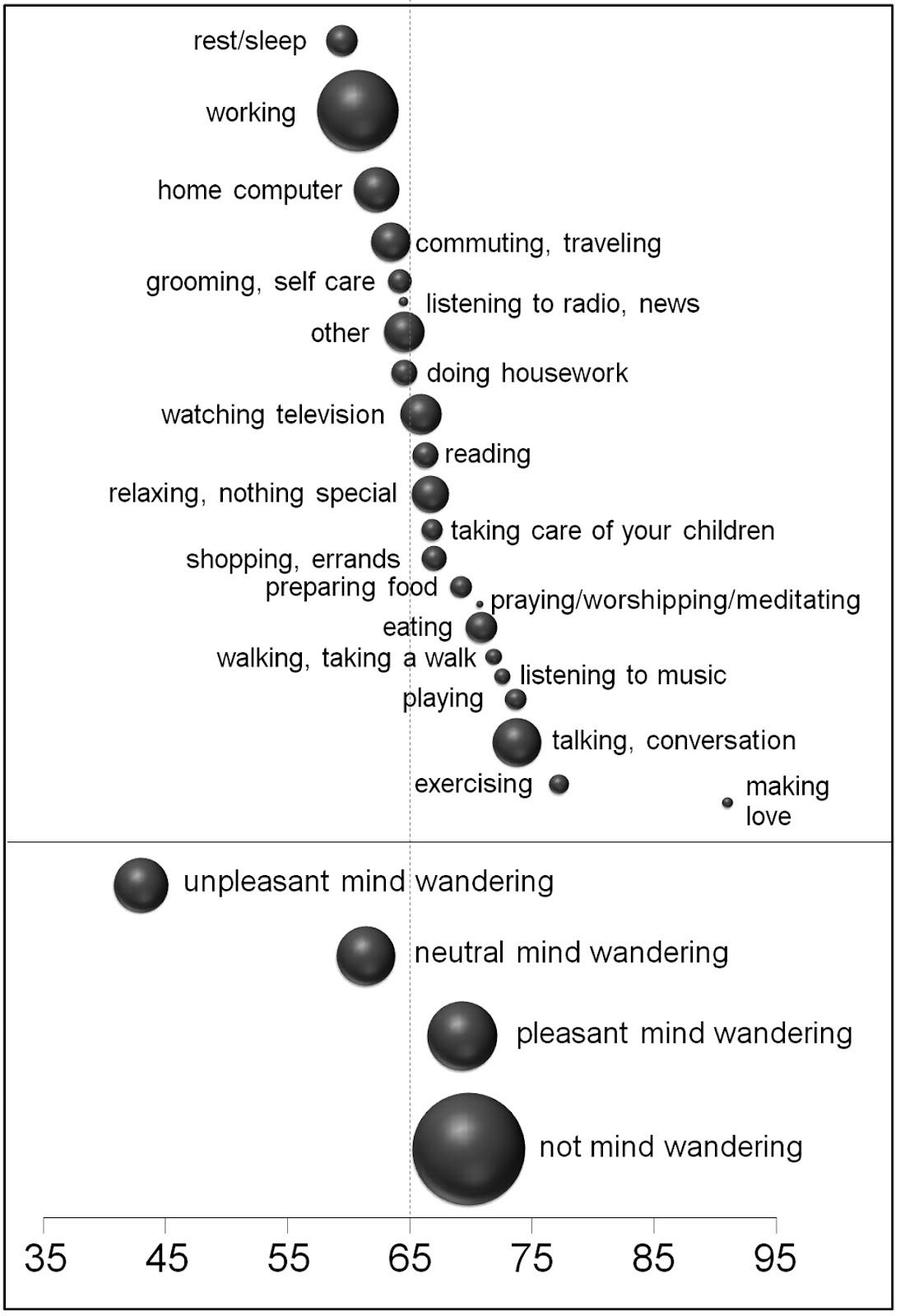
X-axis is the reported happiness level in the seminal study
Stat Insight: Mind-wandering explained over 10% of the variance in happiness—more than the activity people were engaged in. This means that—when it comes to our mental and emotional health—the quality of our attention matters more than whatever we happen to be doing in the moment.
Counterintuitive Finding: Daydreaming positively didn't boost happiness beyond simply being present.
What This Tells Us About Flourishing
As contemplative scientists, we often say: flourishing is a trainable skill. This study emphasizes two key insights:
Attention is foundational—it opens the door to emotion regulation and self-regulation, insight, connection, and purpose.
The default mode is rarely neutral—the human brain naturally simulates, remembers, and plans, but unchecked, this can erode present-moment well-being.
Years of research confirm: simple daily practices—even a few minutes—can meaningfully reduce mind-wandering, enhance awareness, and boost mental health.
There is plasticity here. That’s the good news.
From Awareness to Practice
So what do we do with this insight?
First, we wake up to the reality of distraction. Not as a moral failing — but as a conditioned, transformable pattern. Start by simply noticing: Where is my mind right now? That question alone, asked once or twice a day, begins to shift the circuitry.
Second, we reframe presence not as some mystical attainment, but as a practical skill that supports our mental health and emotional wellbeing. You don’t need to sit in silence for hours. You just need to come back — again and again — to what’s happening right here, in this moment.
Finally, we extend compassion to ourselves and others. Everyone’s mind wanders. What matters is not perfection, but practice. And every time you notice you’ve wandered, that’s a moment of awareness. That’s the training.
Practice Prompt: Try a daily Distraction Check-In. Ask: “Am I here, or am I somewhere else?”
Remember: The moment you notice distraction, you’re no longer caught in it. That moment is the practice.
We’ll be unpacking more on attention and trainability soon. Until then, gently notice where your mind goes—and come home.
Warmly,
Richie + Cort
P.S. We’d love to hear from you—how does distraction show up in your daily life? What helps you return to the present moment? Share your reflections and experiences with us. Your insights make this community richer and our understanding deeper.
Reference Notes:
In case you missed it earlier this week, Richie and Cort discuss The Most Important Thing (Hint: It may have to do with Kindness and Compassion):
Also, tune in for a 9 minute guided-meditation by Cort on your own time on Overcoming Dissatisfaction (Meant to accompany Dharma Lab’s inagaural post: Scottie Scheffler piece HERE)

Thank you for a great article. I have a question. Are there any positives with mind wandering?
Some scholars have suggested that the brain network (default network) activated during mind wandering plays a role in understanding other people’s mental states: people are better at reading other people s minds after mind wandering…
It could therefore serve a purpose.
It would be interesting to hear Richie’s and Cortland’s opinion about this.