

Burnout isn’t just a buzzword anymore — it’s a lived reality for millions. The World Health Organization now classifies it as an occupational phenomenon, one that can erode our health, our relationships, and even our sense of self.
Burnout includes symptoms such as:
Emotional exhaustion — the tank is empty, no matter how much you rest.
Loss of joy — things that once gave energy now feel dull.
Feeling “dried up” — a sense of being depleted at the core.
Reduced personal accomplishment — the painful belief that your work, or even you, no longer matter.
Often, it’s accompanied by anxiety and depression, compounding the cycle of distress.
For a nurse in Mexico, it looked like crying on the bus ride home, then getting up the next morning to face the same overwhelming load.
For a teacher, it was dragging through the day with nothing left to give their students — or their own family.
For a corporate employee, it might be staring blankly at a screen, unable to care about deadlines that once felt urgent.
This is the hidden epidemic of our time.
Encouraging Findings to Start Healing
A groundbreaking study published this week in JAMA Internal Medicine titled “Digital Well-Being Training With Health Care Professionals” shows that burnout isn’t inevitable — and it doesn’t take a massive overhaul to start turning things around.
The study followed over 2,300 healthcare workers across 7 states in Mexico, many of them stretched to the breaking point. The intervention was simple but powerful: a 13-week program combining short digital practices (online sessions with the Healthy Minds Program app) with group sessions led by doctors and facilitators from their own communities.
And the results?
Significant reductions in distress, emotional exhaustion, anxiety, and depression
Improvements in purpose, emotional resilience, and overall well-being
Notably, these positive effects became even stronger six months after the program ended, which is rare for such interventions.
Remarkably, awareness alone explained more than 70% of the reduction in distress — showing how even small shifts in mental habits can have a major impact.
Data from JAMA Aug 18, 2025 Article Below
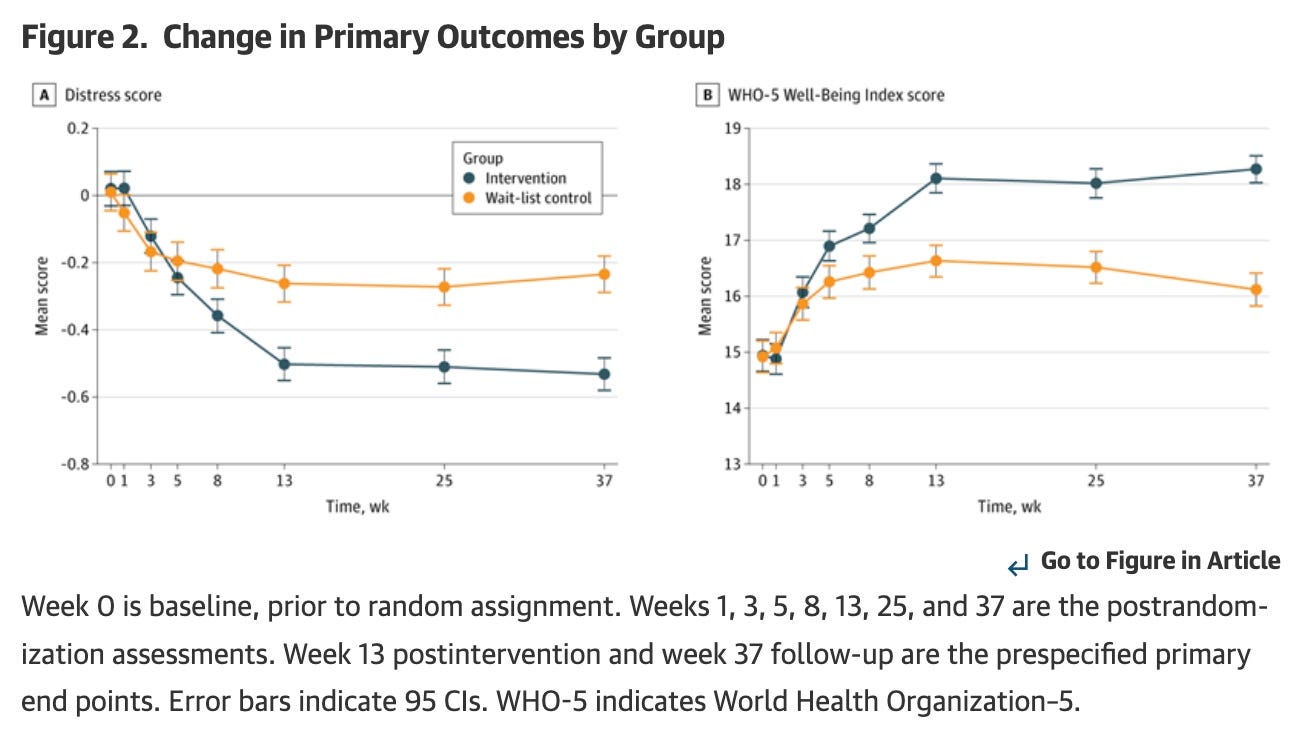
Figure 2 from:
Hirshberg MJ, Davidson RJ, Velarde Arrisueño LB, et al. Digital Well-Being Training With Health Care Professionals: A Randomized Clinical Trial. JAMA Intern Med. Published online August 18, 2025. Figure 2. doi:10.1001/jamainternmed.2025.3888
From Epidemic to Empowerment
Burnout doesn’t just affect doctors or nurses — it’s showing up everywhere: in classrooms, boardrooms, and living rooms. Our nervous systems are like old wiring, never designed for the load we now carry. Constant notifications, endless demands, and the weight of uncertainty all pile on until the system blows a fuse.
The hopeful news is this: with just minutes a day of the right kind of support — building Awareness, Connection, Insight, and Purpose (ACIP) — people can rewire how they respond to stress. Small daily shifts create ripples that add up to profound change.
Dharma Lab Podcast: Beyond Burnout, a Research Discussion
In our next Dharma Lab Podcast episode, Beyond Burnout, we’ll sit down with some of the scientists behind this study — including Richie Davidson, Daniela Labra, Leandro Chernicoff, and Cortland Dahl — to explore:
What burnout really does to the brain and body
Why short, flexible practices can make such a difference, and are accessible "anywhere, all the time"
Stories from frontline healthcare workers who transformed their lives
How we can scale these solutions — not just for healthcare, but for schools, workplaces, and communities everywhere
Exerts from the Beyond Burnout podcast:
"Our bodies, our brains, our nervous system are like a house that was built in a different generation. And we have this electrical system that maybe in the 1950s, it made sense. You know, you had a refrigerator, maybe one or two appliances, a few things plugged in, and now we're charging our cars. We have five computers and 18 phones and a gazillion different things. And the house just was not built to handle all of that. It was built for a different time. And that's basically what's going on with our nervous system. So it feels like a personal failing, but it's simply because we didn't evolve as a species to handle all the information that we have.” - Dr. Cortland Dahl
"We are all participants in a grand experiment for which none of us have provided our informed consent. And that grand experiment is this new "information age" in which we're living, and the rate at which we are recipients of information is unprecedented. And this creates a constant kind of stress that humans have never faced before in human history." - Dr. Richie Davidson
Meet the researchers behind the discussion in our latest episode of Dharma Lab:
Burnout may be a global epidemic. But it’s not inevitable. Healing is possible — even in just a few minutes a day.
Reference Notes:
Link to the study: JAMA Internal Medicine Study
Explore the Healthy Minds Program app used in the study
Share the episode with someone on the edge of burnout — it could change their life
"Our nervous systems are like old wiring, never designed for the load we now carry."
I find this really metaphor really useful and see myself offering it up to others. Thank you