


I was standing in line at a coffee shop and stepped up to place my order, but before a single word came out, I felt a surge of blood rushing to my face. My cheeks were burning. I looked down awkwardly to hide my reaction and quickly shuffled away as soon as I paid.
I come from a family of world-class blushers. Something about the Scandinavian complexion makes it impossible to hide. The blood rushes up, the cheeks burn, and everyone can see it. But this time there was no reason for it. I wasn’t embarrassed about anything. I was just ordering a cup of coffee. Yet there it was, this sudden flood of vulnerability, and a surge of embarrassment that caught me completely off guard.
That small moment turned out to be the beginning of something that followed me for months. And to explain how I got there, and how it played out, I have to go back a little.
A New Kind of Practice
This whole coffee shop episode happened back in 1999, when I had just moved to Boulder, Colorado to start a Master’s Degree program studying Buddhist meditation and philosophy. By then I had been meditating seriously for about six years. I had spent time in Asia, done some immersive retreats, and was meditating a lot, usually at least an hour or two every day. But almost all of that practice had been mindfulness, especially body scan meditation and mindful breathing.
Boulder was where I encountered the Tibetan tradition for the first time. I met some remarkable Tibetan lamas, and I started experimenting with practices that were completely new to me. The one that made the greatest impact was a form of meditation linked to kindness and compassion called tonglen in Tibetan, which means “sending and taking.”
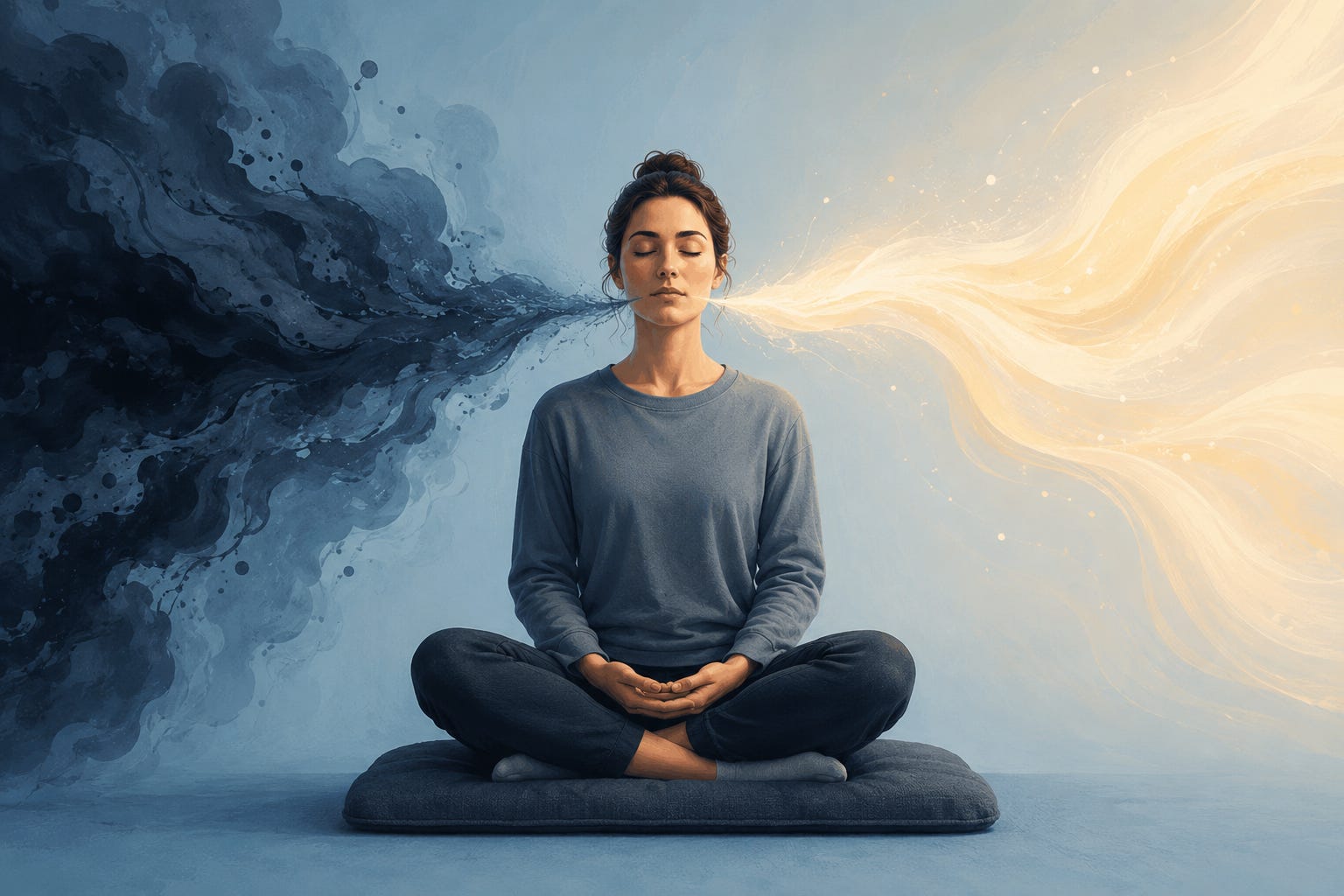
It is one of the strangest practices I know, at least from the standpoint of ordinary common sense. On the out-breath, you share all the things you value and cherish. You imagine giving away your happiness, your good qualities, anything you hold dear. You send it out into the world, sometimes to one person. Sometimes to someone you can’t stand. Sometimes to all beings everywhere. Then, on the in-breath, you take in all the things you resist and fear. You breathe in other people’s suffering. You imagine taking on their illness, their hardship, their anxiety, imagining it as a dark, heavy, toxic vapor flooding into you.
It sounds insane. And it is insane, if you’re operating from your usual mindset, the one where the whole project of life is to secure your own well-being and protect whatever fragile happiness you’ve managed to scrape together. Tonglen runs directly against that.
The logic underneath it is that at the deepest level we are already whole. There is a fundamental well-being in us that nothing can touch and nothing can deplete. So when you give everything away, you don’t end up empty. The giving actually puts you in closer contact with that inner abundance. And when you breathe in the world’s suffering, it doesn’t overwhelm you. It dissolves the fear that you can’t handle hard things. What it produces, paradoxically, is a kind of fearlessness. You can give, you can help, you can take things on, and instead of burning out, you feel more in touch with a strength that doesn’t run dry. It’s almost impossible to believe until you feel it for yourself.
Vulnerability
This was the practice I was experimenting with when the blushing episode happened.
You might expect that doing a meditation focused on kindness, love, and compassion would be all warm and fuzzy, but this was not what happened at all. My reaction took me completely by surprise. In part, I was fascinated. It was like being handed a map to terrain I hadn’t known existed. But it took me way out of my comfort zone as well. The first thing it showed me was how much my practice had been about me. My needs, my preferences, what I wanted, what I was avoiding. And here was a practice built entirely around others. Not even just the people I knew, but “all beings”, the phrase you hear constantly in the Tibetan tradition. I was suddenly doing my small daily meditation in service of something enormous, and it forced me to look at a question I had never really asked: what is my actual motivation, not just for meditating, but for everything I do? I was a little stunned to realize I had gone that long without examining something with such huge implications.
Then came the harder thing, the part that started in the coffee shop.
That unexpected blushing episode was not a one-time event. It spread. Within a short time it was showing up in every interaction I had. Passing conversations with friends. Small talk with strangers at a store or a restaurant. All those tiny human exchanges you normally never think about were suddenly soaked in this feeling of exposure, and the instant, visible flush that came with it. I felt like an open wound.
I know how minor this sounds. Blushing is certainly not a major life crisis. But imagine that every single interaction you have, all day, every day, carries a low hum of awkwardness and embarrassment. That was my life for a few months, and it was painful.
The intense feeling of vulnerability dropped me right back in the social anxiety I struggled with in my late teens, and I could feel exactly where it wanted to take me. It made me want to stop interacting with people altogether. I knew the pull toward avoidance well, and I knew where it led. It meant indulging my most introverted tendencies. I’m genuinely happy alone and can go a long time in solitude without a problem. But in this case, the temptation to withdraw wasn’t a retreat to the peace of solitude. It was retreat as escape, pulling back from people just to avoid uncomfortable feelings.
But I was well into my meditation by this point, so I did my best to practice with it.
The first approach I tried was my old standby: mindfulness of the body. To just feel what I’m feeling. I would bring awareness right into the body, into the burning cheeks, the rising heat, the urge to bolt, and instead of trying to fix any of it, I’d just let it be there. Not letting it take over, but holding space for it while the energy moved through.
The second was tonglen, and this is the one that truly changed things, the one I still lean on most when life gets hard. When the feeling came up, or even just the memory of it, there was always that instant flinch, the unconscious wish to be rid of it. Tonglen takes that flinch and turns it inside out. Instead of pushing the feeling away, you pull it in. You ask for more. I would think: it isn’t only me. So many people know this exact shame and awkwardness, and far worse. May I take all of it in, everyone’s, breathing it in. And whatever scrap of ease or confidence I have, I won’t hoard it. I’ll send it out. Let them have it, even if I’m left with nothing. May everyone else feel calm and steady.
It was not overnight. But this opening of the heart turned out to be every bit as much of a revolution as the mindfulness practice had been years earlier.
Twenty-Five Years Later, in Kathmandu
It has now been more than 25 years since I first practiced tonglen, and it still feels as alive and useful to me as it did in those first strange months. I find endless occasions to use it.
A recent one: I was in Kathmandu for a three-week retreat with one of the great masters of the Tibetan tradition, Tai Situ Rinpoche. Near the end of it, I ran into a health scare.
It started with my feet. They were badly swollen, and then came a tightness in my chest and shortness of breath for no reason I could point to. That last part frightened me, because my family has a serious history with heart disease. My father nearly died from an enlarged heart at about the age I am now, and other people close to me have faced heart failure and blood clots. So these particular symptoms are very familiar to me, and I know they can signal very serious health issues.
I let it go for about a week before getting it checked, and it turned out I had mild pulmonary edema, fluid in the lungs, along with critically low levels of the proteins that keep blood from clotting. And I was stacked with clot risk factors all at once: high altitude, heat and humidity, an immune system worn down by sitting in a large group where a cold was tearing through everyone, digestive trouble from the food, and long hours sitting still.
The symptoms came and went. Sometimes at night. Sometimes right in the middle of a session, while I was sitting there meditating.
But the hardest part wasn’t the symptoms. It was not knowing. Was this just my body reacting to a perfect storm of adverse conditions - unpleasant but ultimately benign? Was it something I could relax into and ride out? Or was it the warning signal of something that needed urgent attention? That uncertainty, the not-knowing, is so often the most difficult thing to sit with.
So I did what tonglen had taught me 25 years earlier. First, just feel it. Notice the fear, the racing inner narrative, the sensations in the chest and the feet. Don’t push it away and don’t feed it. Let it be there.
Then, sending and taking. I thought about everyone I know who is dealing with something like this, some of them facing far worse. And beyond them, the countless people I’ll never meet who live every day with chronic pain or serious illness or fear about their own bodies. I imagined breathing all of it in, and wishing them free of it. Whatever health and steadiness I have, can I share it with them? May they have it.
It did not change my symptoms. It didn’t erase the fear or hand me an answer about what was happening. But the space around all of it changed completely. It connected me to a sense of meaning, and to a strange, steady confidence that whatever came, I could handle it. A few breaths like that could move me out of brace-and-resist and into open-and-explore. It gave me the inner space to respond with care and self-awareness instead of getting swept up in the energy of self-preservation and blind reaction. But more importantly, it dropped me into the space of feeling deeply connected with others. That whatever is going on, I’m not alone, and others who are suffering are not alone. We are part of a vast web of life, and I can let that feeling of connectedness carry me through a scary moment.
Try It for Yourself
That, more or less, is what these heart-opening practices can do. Not only on the cushion, but in exactly the moments when we tend to contract and pull back from the rough edges of being human. And tonglen is only one entrance. The inner landscapes of insight, of wisdom, of purpose and meaning, are all just as worth exploring, and just as helpful for navigating the ordinary ups and downs of a life.
If you’d like to experiment with this practice, here are some simple instructions.
Step 1: Prepare your mind and body
Find a comfortable posture, close your eyes if you like, and bring a light awareness into your body.
Take a moment to notice how you’re feeling. Are there areas of tension or discomfort? Places where you feel relaxed or at ease? There’s nothing to change—just notice what’s present and rest with your experience for a few moments.
Step 2: Taking In
Next, reflect on your life these days. Is there something you’re struggling with or finding a little challenging? To begin, choose something that isn’t too overwhelming. A situation that’s mildly stressful or frustrating is perfect.
Bring it to mind and simply notice what happens. What thoughts arise? What emotions? What sensations do you feel in your body?
Now widen the lens.
Think of other people—people you know and people you don’t. Some may be facing similar challenges. Others may be dealing with difficulties far greater than your own.
Hold all of them gently in your heart with a simple wish such as:
May they all be free from suffering.
May they all find peace.
Or use whatever words feel most natural to you.
Next, imagine that with each in-breath you are breathing in their suffering and challenges. If it helps, picture it as dark smoke or vapor. As you breathe it in, imagine being completely fearless. Imagine that you’re breathing it into the deepest part of yourself—the part that cannot be harmed, damaged, or poisoned.
With every breath, allow yourself to feel more confident, resilient, and strong, and imagine that those you’re thinking of are completely relieved of their suffering, as though your compassion is genuinely supporting them.
You can stay with this part of the practice as long as you like. From time to time, feel free to pause and bring awareness into your body, or simply rest in effortless awareness for a minute or two before continuing on.
Step 3: Sending Out
If you’d like to include the second half of the practice, begin breathing out your own positive qualities.
Imagine sharing your resilience, kindness, wisdom, health, joy, or whatever goodness you have to offer. You might visualize it as radiant light flowing out in every direction, touching others and helping them reconnect with their own courage and inner strength.
Step 4: Breathing In, Breathing Out
Finally, you can put these steps together. Breathe in all the pain, suffering, and negativity, and breathe out goodness, positive feelings and circumstances, and joy. You can use whatever naturally comes up in your experience as an opportunity to extend even further:
If you notice fear, breathe in the fear of all those who feel afraid.
If you notice resistance, breathe in resistance.
If you notice confusion, breathe in confusion.
Whenever you feel calm, confident, joyful, or strong, breathe those qualities back out into the world.
There is no need to be rigid. Let the practice unfold naturally in whatever way feels meaningful.
Step 5: Rest
When you’re ready, let go of the visualization completely.
Simply rest in open, effortless awareness, as though you’re quietly holding space for a dear friend. Allow whatever is happening in your body and mind to unfold naturally, without trying to change anything. Give yourself a genuine opportunity to simply rest and be present.
As with any meditation practice, keep it light and playful. If at any point it feels like too much, simply take a break. Over time, however, you may discover, as I have, that this becomes one of the most rewarding and transformative practices you can do.
As always, I’m sharing this in the hope that it adds a little something to your day. Maybe you already do these practices and have your own experience with them. Maybe this is entirely new ground for you. Either way, I’d love to hear it. If you’ve practiced tonglen, how has it shown up in your life? And if it’s new, what does it stir up, doubt, curiosity, resistance, interest? Tell me in the comments.
Wishing you all the very best for your journey,
Cort
Our free 1-week online summit providing insights for understanding and Quieting A Restless Mind is coming up in November. More details and link to register below.

As others have said, this is beautiful. My husband and I are on the verge of filing for divorce and I have allowed myself to be mired in all the unknowns. Sitting and practicing through your guidance has reminded me (again) of all that I have to be grateful for and all that I have to give and be of service to others... Thank you Cort.
"There are no accidents." I read this upon awakening from a dream representing my fear and ambivalence about attending a Mussar (Jewish ethics) class for the first time in person at a synagogue 30 miles from where I live. I've never been there before. I have a history of trauma-drama with the Jewish community. How will I be received? Will people like me? Maybe I just won't go! I'm driving an old car and maybe it will break down!
In the dream I'm with these people. Then the scene changes and I'm in a neighborhood of old mansions, like ones I'm familiar with from growing up in Oklahoma -- oil country. I grew up surrounded by wealth, status, power. Some of it was passed down to me from my father's family.
Upon awakening and after writing down the dream, I turned to my phone and read this post! Synchronicity. I wish I could afford to attend Naropa! I am recovering from a heart attack. I am hyper-alert to symptoms and dread the possibility of facing another heart attack. I also just got an "all-clear" report about a skin cancer on my face. I feel renewed and reprieved! I shared this post with the rabbi of the congregation. Now I have a way to face my own fear and meet these folks I've never met before from my tender vulnerable heart, trusting all will be well.
Thank you Cort! Thank you Ritchie! Thank you, Dharma Lab!